As the Islamic New Year approaches — marking the start of Muharram — Muslims around the world pause to reflect, renew their faith, and turn to Allah with sincere dua. Unlike the secular New Year, celebrated with fireworks and countdowns, the Islamic New Year carries a deeply spiritual meaning rooted in sacrifice, migration, and renewed commitment to Allah.
This guide walks you through the authentic new year dua, the historical and Quranic significance behind the Islamic calendar, and practical ways Muslims in the UK, USA, and Canada can mark this occasion meaningfully — whether at home, at the masjid, or simply in quiet personal reflection.
Because the Hijri calendar shifts each year relative to the Gregorian one, the Islamic New Year doesn’t fall on a fixed date — it moves roughly ten to eleven days earlier every year. For many Muslims living outside Muslim-majority countries, this can make it easy to miss entirely amid the routine of daily life, work schedules, and school terms. That’s exactly why understanding the dua for new year and the wisdom behind it is so valuable — it gives you a simple, portable practice you can carry with you no matter where in the world you are, or how busy the season gets.
What Is the Islamic New Year?
The Islamic New Year begins on the 1st of Muharram, the first month of the Hijri (lunar) calendar. This calendar was formally established during the caliphate of Umar ibn Al-Khattab (may Allah be pleased with him), who chose the year of the Hijrah — the Prophet’s ﷺ migration from Makkah to Madinah — as the starting point of Islamic timekeeping.
This is an important distinction: the Islamic New Year doesn’t commemorate a birth or a celebration in the way many other new year traditions do. It commemorates a migration — a moment of sacrifice, trust in Allah, and the beginning of the first Muslim community in Madinah. That’s why the Islamic New Year is traditionally observed with reflection and worship rather than festivities.
Allah confirms the sacred structure of the Islamic calendar in the Quran:
“Indeed, the number of months with Allah is twelve [lunar] months in the register of Allah [from] the day He created the heavens and the earth; of these, four are sacred.” (Surah At-Tawbah, 9:36)
Muharram is one of these four sacred months, alongside Dhul-Qa’dah, Dhul-Hijjah, and Rajab — making the start of the Islamic New Year not just a calendar milestone, but a spiritually significant one.
The Dua for New Year in Islam
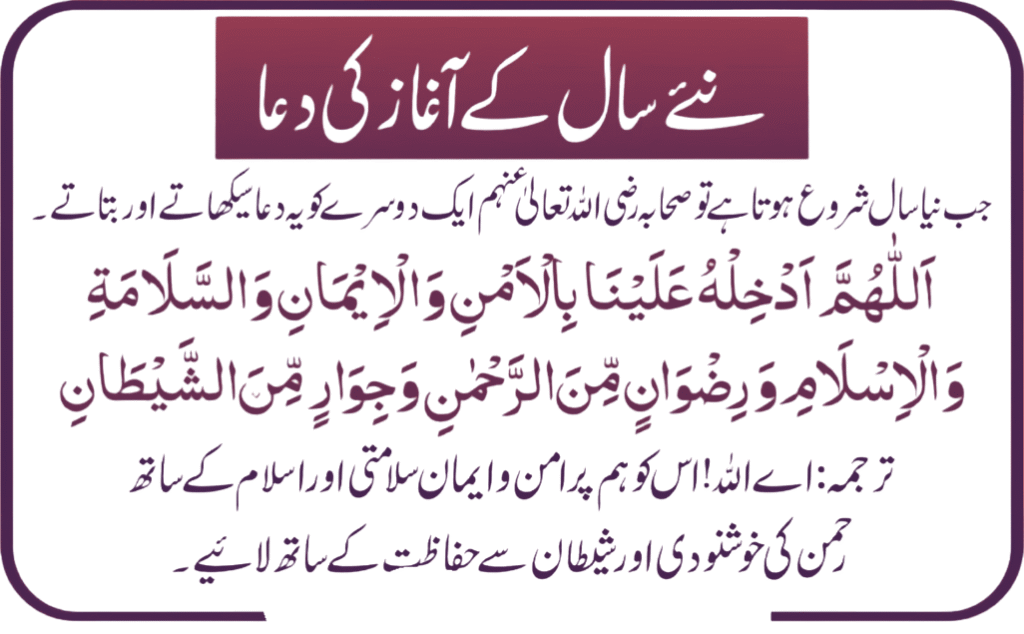
There isn’t a separate, distinct dua that the Prophet ﷺ specifically taught for the 1st of Muharram. Instead, scholars generally recommend reciting the same authentic dua taught for the sighting of any new moon, since the Islamic New Year begins with the sighting of the Muharram crescent like every other Hijri month.
This dua is narrated by Talha ibn Ubaydullah (may Allah be pleased with him), who reported that whenever the Prophet ﷺ saw a new crescent moon, he would say:
Arabic: اللَّهُمَّ أَهِلَّهُ عَلَيْنَا بِالْأَمْنِ وَالْإِيمَانِ، وَالسَّلَامَةِ وَالْإِسْلَامِ، رَبِّي وَرَبُّكَ اللَّهُ
Transliteration: Allahumma ahillahu ‘alayna bil-amni wal-iman, was-salamati wal-Islam, Rabbi wa Rabbuka Allah.
Translation: “O Allah, bring it (the new moon) upon us with security and faith, safety and Islam. My Lord and your Lord is Allah.”
This is recorded in Jami’ at-Tirmidhi (Hadith 3451), graded hasan gharib. Since the Islamic New Year is, at its core, the sighting of a new lunar month, this dua is entirely fitting — and reciting it at the start of Muharram carries added weight, given that it marks the beginning of an entire new year, not just a new month.
Read More : https://theorbitquran.com/dua-for-new-month-in-islam/
A Simple Additional Dua for the New Year
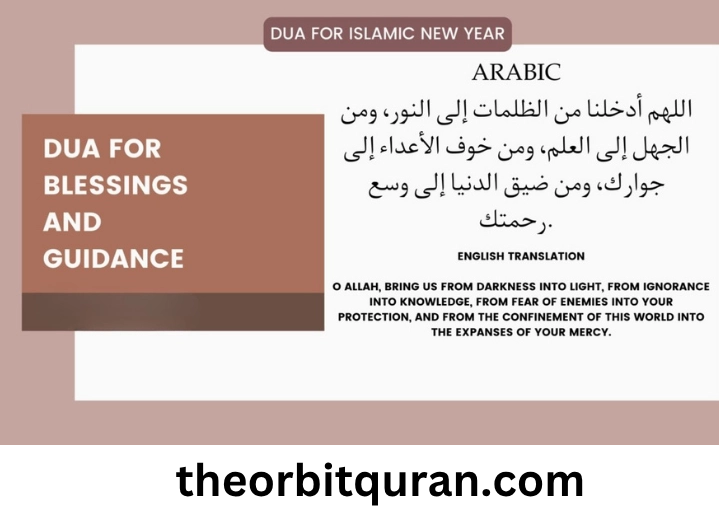
Alongside the Prophetic new moon dua, many Muslims add a personal supplication asking Allah for guidance, protection, and blessing in the year ahead. A commonly recited addition is:
Transliteration: Allahumma balligh-na Ramadan, wa a’inna ‘ala dhikrika wa shukrika wa husni ‘ibadatik.
Translation: “O Allah, let us reach Ramadan, and help us to remember You, thank You, and worship You in the best manner.”
While this particular phrasing is more closely associated with the months leading up to Ramadan, its spirit — asking Allah for a full year of remembrance, gratitude, and good worship — captures exactly what many Muslims hope for at the start of a new Hijri year. You are free to make dua in this spirit, in your own words, in any language you’re comfortable with, as Allah understands every language and every sincere heart.
Why Muharram Deserves Special Reflection
Beyond the new year dua itself, Muharram carries several layers of significance that make it a powerful time for worship and self-reflection:
1. It Marks the Hijrah
The Hijrah wasn’t just a physical relocation — it was an act of complete trust in Allah. The Prophet ﷺ and his companions left behind their homes, wealth, and family ties in Makkah to establish a new community built on faith. They faced uncertainty, danger, and the loss of everything familiar, yet they placed their full trust in Allah’s plan. Reflecting on this story at the start of the Islamic year is a reminder that sometimes the most meaningful growth requires leaving comfort behind for the sake of Allah — whether that means letting go of a bad habit, a toxic environment, or simply the comfort of spiritual complacency.
This is also why the Hijri calendar begins with the Hijrah rather than the Prophet’s ﷺ birth or the first revelation. Islamic scholars have noted that the migration represented the point at which Islam transitioned from a persecuted message in Makkah to an established, functioning community in Madinah — a turning point worth commemorating every single year.
2. The Day of Ashura
The 10th of Muharram, known as Ashura, holds particular virtue. The Prophet ﷺ was asked about fasting on this day, and he said that it expiates the sins of the previous year (Sahih Muslim, Hadith 1162). Many Muslims choose to fast on the 9th and 10th (or 10th and 11th) of Muharram, following the Prophet’s ﷺ guidance to differ slightly from the fasting practice of the People of the Book.
3. A Sacred Month
As mentioned in Surah At-Tawbah 9:36, Muharram is one of the four sacred months in which Allah has asked believers to be especially mindful of their conduct, avoiding wrongdoing and increasing good deeds.
How to Mark the Islamic New Year Meaningfully
For Muslims living in the UK, USA, and Canada, where the secular new year (January 1st) tends to dominate public attention, the Islamic New Year can easily pass by unnoticed unless you intentionally make space for it. Here are a few practical ways to observe it:
- Recite the new moon dua upon the sighting or announcement of the Muharram crescent.
- Fast on the 9th and 10th of Muharram (Ashura), following the Sunnah.
- Reflect on the Hijrah — read or share the story of the Prophet’s ﷺ migration with your family or children.
- Set spiritual goals for the year ahead, much like people set resolutions for the Gregorian new year — but rooted in worship, character, and closeness to Allah.
- Increase dua and istighfar (seeking forgiveness) as you transition from one year to the next, using it as a natural checkpoint to reflect on personal growth.
- Attend a khutbah or gathering at your local mosque, many of which hold special reminders around the significance of Muharram and Ashura.
Read More : theorbitquran.com
Common Questions About the Islamic New Year Dua
Is there a hadith with a specific “new year dua” separate from the new moon dua? No authentic, specific dua exists solely for the 1st of Muharram. The established Sunnah is to recite the general new moon dua, since the Islamic New Year begins with a new lunar sighting like any other month.
Should Muslims celebrate the Islamic New Year like the Gregorian New Year? The Islamic New Year is not marked with celebrations, parties, or festivities in the Sunnah. It is instead a time for reflection, gratitude, and increased worship — particularly given its connection to the Hijrah and the sacred month of Muharram.
Is fasting on Ashura obligatory? No, fasting on the 10th of Muharram (Ashura) is highly recommended (mustahabb) but not obligatory. It carries significant reward, as it is reported to expiate the sins of the past year.
Can I make dua in English instead of Arabic? Yes. While reciting the Prophetic dua in Arabic is best when possible, personal supplications can be made sincerely in any language, including English.
What’s the difference between the Islamic New Year and Ashura? The Islamic New Year falls on 1st Muharram, marking the start of the Hijri year, while Ashura falls on the 10th of Muharram — ten days later. The New Year is about reflection and renewal, while Ashura specifically carries the virtue of fasting and sin expiation.
Do different Muslim communities mark Muharram differently? Yes. While the general Sunnah practice — new moon dua, reflection on the Hijrah, and fasting on Ashura — is shared across the Muslim world, some communities observe additional local customs or commemorations during this month. It’s always worth checking with your local mosque or community for guidance specific to your context.
Contact Us : Contact Us
Final Thoughts
The Islamic New Year offers Muslims a unique opportunity — not for celebration in the worldly sense, but for reflection, renewal, and gratitude. By reciting the authentic new moon dua, remembering the sacrifice of the Hijrah, and observing the virtues of Muharram and Ashura, believers can begin the new Hijri year with sincerity and purpose.
Wherever you are — in the UK, USA, Canada, or anywhere else in the world — let this new year be a reminder that time itself belongs to Allah, and every fresh beginning is a chance to draw closer to Him.
Disclaimer: This article is intended for general Islamic educational purposes. For matters of personal religious practice or specific fiqh rulings, please consult a qualified local scholar or imam.