

Anxiety, depression, and overthinking are struggles that touch almost everyone at some point in life — and as Muslims, we’re fortunate to have a faith that speaks directly to these emotions with both compassion and practical guidance. The Quran and Sunnah are full of reminders, duas, and surahs that soothe the heart and offer real comfort during difficult mental and emotional seasons.
This guide brings together the most authentic dua for anxiety, relevant Quranic verses, and practical spiritual tools that Muslims in the UK, USA, and Canada can turn to when anxiety, depression, or overthinking start to feel overwhelming.
Please note: this article offers spiritual and religious guidance rooted in Islamic teachings. It is not a substitute for professional medical or mental health care. If you are struggling with persistent anxiety or depression, please also reach out to a doctor, therapist, or counsellor seeking professional help alongside spiritual practice is both wise and encouraged in Islam.
Islam and Mental Health: A Compassionate Starting Point
It’s important to first understand that Islam does not view anxiety or sadness as a sign of weak faith. Even the Prophets experienced deep grief and distress. Prophet Ya’qub (Jacob) wept until his eyesight weakened out of grief for his son Yusuf (Joseph). Prophet Muhammad ﷺ himself experienced what is known in the Seerah as “the Year of Sorrow” (Aam al-Huzn), following the death of his beloved wife Khadijah and his uncle Abu Talib.
Allah says in the Quran:
“Allah does not burden a soul beyond that it can bear.” (Surah Al-Baqarah, 2:286)
This verse is a powerful reminder that whatever hardship you’re facing including anxiety or depression is something Allah, in His infinite wisdom, has decreed you’re capable of bearing, even when it doesn’t feel that way in the moment.
The Authentic Dua for Anxiety and Sorrow
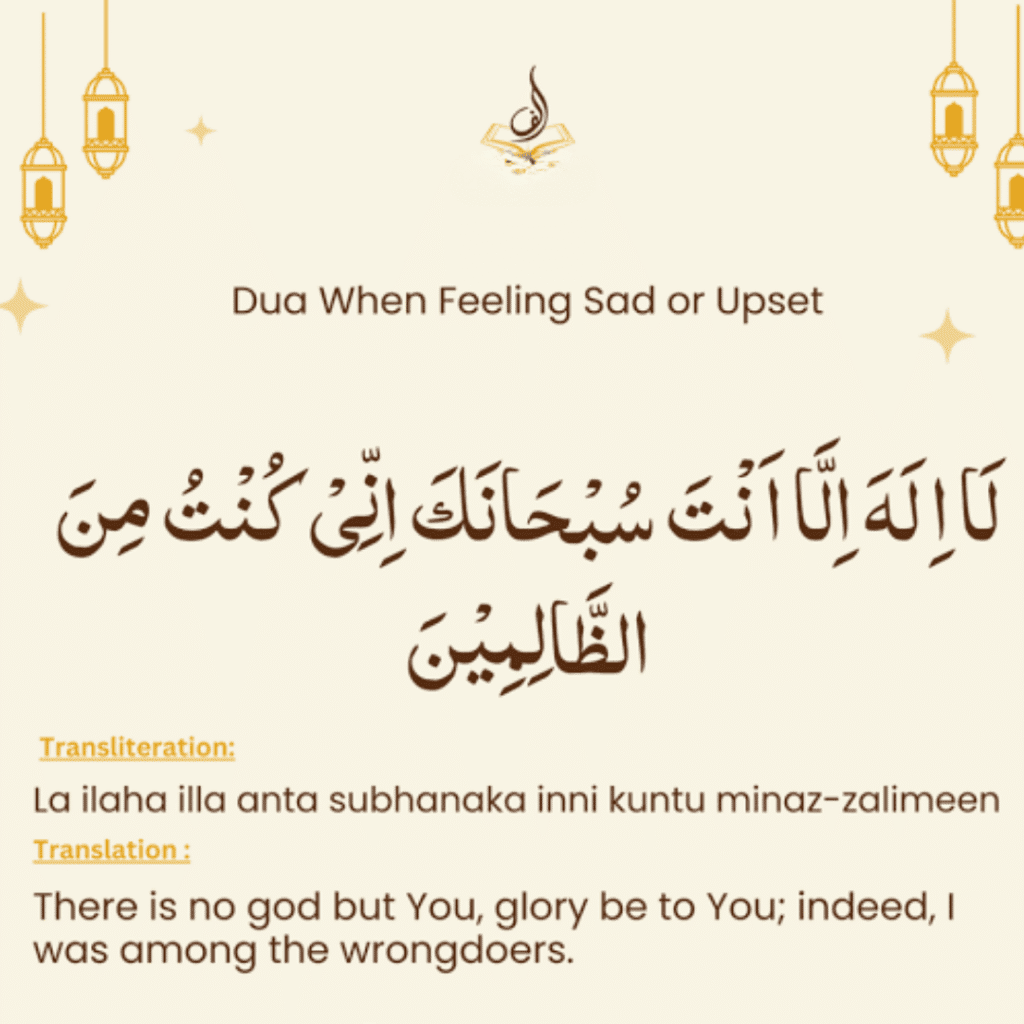
One of the most well-known and authentic duas for anxiety comes from a hadith narrated by Anas ibn Malik (may Allah be pleased with him). The Prophet ﷺ used to say:
Arabic: اللَّهُمَّ إِنِّي أَعُوذُ بِكَ مِنَ الْهَمِّ وَالْحَزَنِ، وَالْعَجْزِ وَالْكَسَلِ، وَالْجُبْنِ وَالْبُخْلِ، وَضَلَعِ الدَّيْنِ وَغَلَبَةِ الرِّجَالِ
Transliteration: Allahumma inni a’udhu bika minal-hammi wal-hazan, wal-‘ajzi wal-kasal, wal-jubni wal-bukhl, wa dala’id-dayni wa ghalabatir-rijal.
Translation: “O Allah, I seek refuge in You from anxiety and sorrow, weakness and laziness, cowardice and miserliness, the burden of debts, and being overpowered by other people.”
This dua is recorded in Sahih al-Bukhari (Hadith 6369), and it directly addresses anxiety (al-hamm, worry about the future) and sorrow (al-hazan, grief over the past) the two emotional states that so often fuel overthinking and depression. The Prophet ﷺ recited this dua regularly, showing us that turning to Allah during emotional distress isn’t just permissible it’s Sunnah.
Dua for Overthinking and a Troubled Heart
Overthinking often stems from a heart that feels unsettled, uncertain, or in need of reassurance. The Quran directly addresses this need for inner stillness:
“Those who believe and whose hearts find rest in the remembrance of Allah. Verily, in the remembrance of Allah do hearts find rest.” (Surah Ar-Ra’d, 13:28)
This verse is often recommended by scholars as a source of comfort for those struggling with racing thoughts or a restless mind. The remedy the Quran points to isn’t complicated — it’s consistent dhikr (remembrance of Allah), whether through short phrases like SubhanAllah, Alhamdulillah, and La ilaha illallah, or through reciting Quran slowly and reflectively.
A simple dua many Muslims turn to during moments of overthinking or spiralling thoughts is:
Transliteration: Hasbunallahu wa ni’mal wakeel.
Translation: “Allah is sufficient for us, and He is the best disposer of affairs.”
This phrase, mentioned in the Quran (Surah Aal-e-Imran, 3:173), is a reminder that no matter how much our minds try to control or predict the future, ultimate control belongs to Allah — and that alone can bring immense relief to an overactive mind.
Best Surahs for Anxiety and Depression
Alongside specific duas, certain surahs are widely recommended by scholars for their calming, reassuring themes. Here are some of the most commonly turned to:
Surah Ash-Sharh (Al-Inshirah) – Chapter 94
This short surah speaks directly to hardship and ease, reminding the reader:
“For indeed, with hardship [will be] ease. Indeed, with hardship [will be] ease.” (Surah Ash-Sharh, 94:5-6)
The repetition here isn’t accidental many scholars note it emphasises that ease doesn’t just follow hardship once, but is guaranteed, again and again, for those who remain patient.
Surah Ad-Duha – Chapter 93
Revealed to comfort the Prophet ﷺ during a period when he felt spiritually low, this surah is a gentle reminder that Allah has not abandoned the believer, and that what comes later will be better than what came before.
Ayat al-Kursi – Surah Al-Baqarah, 2:255
Known as the greatest verse in the Quran, Ayat al-Kursi is frequently recited for protection and peace of heart. Its powerful description of Allah’s total control and knowledge over all things offers deep reassurance to a heart burdened by uncertainty.
Surah Yusuf – Chapter 12
The story of Prophet Yusuf (peace be upon him) is one of patience through betrayal, separation, and hardship. His father Ya’qub’s response to devastating grief “So patience is most fitting” (12:18) models the balance Islam encourages between feeling pain and maintaining hope in Allah.
Practical Ways to Use These Duas and Surahs Daily
Knowing the right dua or surah is only the first step using it consistently is what brings real benefit. Here are some simple, practical ways to weave these into your daily routine:
- Recite the anxiety dua after each obligatory prayer, even just once, to build consistency.
- Set aside five minutes each morning to read Surah Ash-Sharh or Ad-Duha, especially before a demanding day.
- Use dhikr as a grounding tool during moments of overthinking repeating SubhanAllah, Alhamdulillah, and Allahu Akbar slowly can interrupt racing thoughts.
- Recite Ayat al-Kursi before sleep, a Sunnah practice known to bring peace and protection through the night.
- Keep a small dua journal, writing down what you’re anxious about and following it with a short dua — a practice that combines the benefits of journaling with spiritual reflection.
- Pair spiritual practice with practical steps proper sleep, movement, and speaking to a trusted person or professional since Islam encourages taking practical means (asbab) alongside dua.
- Make dua in your own words too after reciting the Prophetic duas, take a few moments to speak to Allah honestly about exactly what’s weighing on you, in whatever language feels most natural.
- Reflect on Allah’s names during difficult moments names like Ar-Rahman (The Most Merciful), Al-Latif (The Subtle, Most Gentle), and As-Sabur (The Patient) can be a source of comfort when repeated slowly and thoughtfully.
When to Seek Additional Support
While dua and Quranic recitation offer genuine comfort and are deeply encouraged in Islam, it’s equally important to recognise when anxiety or depression may need additional support. The Prophet ﷺ himself taught us to seek treatment, saying that Allah has not sent down an illness without also sending down its cure (Sahih al-Bukhari, Hadith 5678) a hadith often cited by scholars to encourage seeking medical and professional help, not just spiritual remedies alone.
If feelings of anxiety, depression, or overthinking are persistent, overwhelming, or affecting your daily life, please consider reaching out to a licensed therapist, counsellor, or doctor. In the UK, USA, and Canada, many mosques and Islamic organisations now also offer faith-informed counselling services that combine professional mental health support with an understanding of Islamic values a helpful bridge for many Muslims seeking care that respects their faith.
Common Questions About Dua for Anxiety
Is it a sign of weak faith to feel anxious or depressed? No. Even Prophets experienced deep grief and sorrow. Feeling anxious or low does not indicate weak iman how you respond, by turning to Allah and seeking support, is what matters.
Can I recite the anxiety dua in English if I don’t know Arabic? Yes. While learning the Arabic is encouraged for its full spiritual reward, sincere dua in English or any language you understand is fully accepted by Allah.
How often should I recite Surah Ash-Sharh or Ad-Duha? There’s no fixed requirement — many people find comfort reciting them daily, especially during difficult periods, though even occasional reflection on their meaning brings benefit.
Should I stop therapy or medication if I increase my dua and worship? No. Islam encourages using all lawful means available, including medical treatment and therapy, alongside spiritual practices like dua and dhikr. They work together, not against each other.
Final Thoughts
Anxiety, depression, and overthinking are real, human struggles and Islam meets them with both deep compassion and practical spiritual tools. The dua for anxiety taught by the Prophet ﷺ, combined with surahs like Ash-Sharh, Ad-Duha, and Ayat al-Kursi, offer genuine comfort rooted in centuries of prophetic tradition.
But remember: seeking Allah’s help through dua works hand in hand with seeking practical support — whether that’s speaking to a professional, leaning on loved ones, or simply giving yourself grace during a hard season. Allah is always near, always listening, and always ready to ease the burden of a heart that turns to Him.
Disclaimer: This article is intended for general Islamic educational purposes and is not a substitute for professional medical or mental health advice. If you are experiencing persistent anxiety, depression, or emotional distress, please consult a qualified healthcare provider or mental health professional.