
Introduction
For Muslims living in the UK, USA, and Canada, the phrase Bismillahir Rahmanir Raheem is one of the first Arabic expressions learned in childhood, yet its depth is rarely explored in daily life. It is the opening phrase of the Quran, recited before almost every chapter, and repeated by believers before eating, traveling, studying, or beginning any lawful task.
This blog post explains the meaning of Bismillahir Rahmanir Raheem, its Arabic text, its English translation, and its fazilat (virtue) according to the Quran and authentic Hadith. Whether you are a new Muslim, a student of Islamic studies, or simply curious about this phrase you hear often, this guide is written for beginners and general readers.
By the end, you will understand not only what the words mean but also why Muslims across North America and the United Kingdom continue this practice every single day of their lives, and how a short Arabic phrase can shape the rhythm of an entire day, from the first moments of the morning to the final moments before sleep.
Bismillah in Arabic: The Original Text
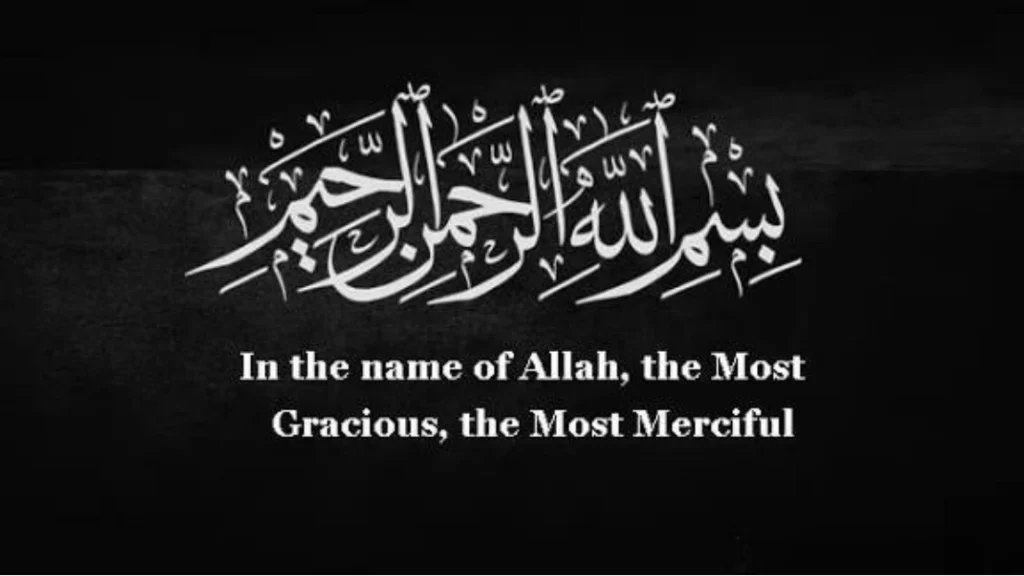
The Arabic text of this phrase is بِسْمِ اللَّهِ الرَّحْمَٰنِ الرَّحِيمِ, transliterated as “Bismillahir Rahmanir Raheem.” It is composed of three distinct parts. The first, “Bismi,” means “in the name of.” The second, “Allah,” is the proper name of God in Islam, used exclusively for the one true Creator and not shared with any created being.
The third and fourth words, “Ar-Rahman” and “Ar-Raheem,” are both derived from the Arabic root “rahmah,” meaning mercy, yet each carries a distinct shade of meaning recognized by classical scholars of Arabic and Quranic exegesis.
Understanding the Arabic structure helps beginners appreciate why this short phrase is considered so linguistically rich, and why translators often struggle to capture its full meaning in a single English sentence. For readers in the UK, USA, and Canada learning Quranic Arabic for the first time, this phrase is often the very first step toward reading the rest of the Quran with correct pronunciation and understanding.
Read More : theorbitequan.com
Bismillahir Rahmanir Raheem Translation in English

The most common English translation is “In the name of Allah, the Most Gracious, the Most Merciful.” Some translators render it as “In the name of God, the Compassionate, the Merciful,” while others prefer “In the name of Allah, the Beneficent, the Merciful.”
According to many scholars, Ar-Rahman refers to Allah’s mercy that encompasses all of creation, believers and non-believers alike, in this worldly life. Ar-Raheem, on the other hand, is often understood to refer to the special mercy reserved for believers, particularly in the Hereafter.
This distinction is why both names appear together rather than just one; each highlights a different dimension of divine mercy. For English-speaking audiences in the UK, USA, and Canada, understanding this nuance adds depth to a phrase that might otherwise seem like a simple greeting formula, and it explains why the phrase is repeated so consistently throughout the Quran rather than being stated only once at the very beginning.
Read More : Darood Tanjeena Benefits: The Prayer of Deliverance Explained
Where Bismillah Appears in the Quran
Bismillahir Rahmanir Raheem appears at the beginning of 113 out of the 114 surahs of the Quran, the sole exception being Surah At-Tawbah (Surah 9). Scholars have offered various explanations for this exception, with many suggesting it relates to the surah’s stern tone regarding broken treaties.
Beyond its role as an opening formula, the phrase itself appears within the body of the Quran in Surah An-Naml. Allah says regarding the letter sent by Prophet Sulaiman (peace be upon him) to the Queen of Sheba: “Indeed, it is from Sulaiman, and indeed, it reads: In the name of Allah, the Entirely Merciful, the Especially Merciful” (Surah An-Naml, 27:30).
This verse shows that beginning important correspondence and tasks with Allah’s name was a practice established even among the earlier prophets, long before the revelation of the Quran to Prophet Muhammad (peace be upon him). It offers Muslims in Western countries a clear Quranic precedent for the habit of starting emails, letters, and important documents with Bismillah, a practice still followed by many Islamic organizations and schools today.
The Fazilat of Bismillah According to Hadith
Islamic tradition places great emphasis on the virtue, or fazilat, of saying Bismillah before beginning any permissible action. One well-documented practice concerns eating.
It is reported that the Prophet Muhammad (peace be upon him) instructed a young companion, Umar ibn Abi Salamah, saying: “Mention Allah’s name, eat with your right hand, and eat from what is nearest to you” (Riyad as-Salihin, Hadith 727, agreed upon by Al-Bukhari and Muslim).
In another authentic narration recorded in Sunan Abi Dawud, Hadith 3767, graded sahih by Al-Albani, the Prophet said that if a person forgets to mention Allah’s name at the start of a meal, they should say “Bismillahi awwalahu wa akhirahu,” meaning “In the name of Allah at its beginning and its end.”
These narrations demonstrate that saying Bismillah is not merely symbolic but is tied to concrete, everyday practice recommended directly by the Prophet himself, connecting an act as ordinary as eating a meal to the remembrance of Allah, and giving parents and teachers in Muslim communities a simple, authenticated habit to instill in children from a young age.
Read more : Contact Us
A Commonly Cited Narration and the Need for Caution
Many Islamic blogs and social media posts circulate a saying that “every important matter not begun with Bismillah is deprived of blessing.” While widely repeated, honest scholarship requires noting that the chains of narration for this specific wording are generally classified by hadith scholars as weak (da’if) rather than authentic (sahih).
This does not mean the underlying concept is false, since the broader principle of beginning good deeds with Allah’s name is firmly supported by the authentic hadith on eating mentioned above and by the Quranic precedent in Surah An-Naml.
However, readers in the UK, USA, and Canada who are building their understanding of Islamic practice should be aware of the difference between authenticated hadith and popular sayings, so that their faith rests on verified foundations rather than folk tradition alone. Sharing such sayings without noting their status can unintentionally spread weak information, so responsible Islamic teaching encourages checking the grading of a narration before presenting it as a firm statement of the Prophet.
Bismillah Rahman Rahim in Everyday Muslim Life
For Muslim communities across North America and the United Kingdom, Bismillah rahman rahim is far more than a religious formality; it is a daily habit that frames ordinary moments with spiritual awareness. Many Muslims say it before starting their car, opening a laptop for work, beginning a meal, or even before falling asleep.
Children in Islamic schools and weekend Quran classes across cities like London, Toronto, New York, and Chicago are taught to memorize this phrase before learning to read the rest of the Quran. This widespread practice reflects a core teaching in Islam: that everyday actions, when consciously connected to the remembrance of Allah, can carry spiritual weight equal to acts of formal worship.
For beginners exploring Islam in Western countries, adopting this simple habit can be an accessible first step toward a more mindful daily routine, requiring no special setting, language fluency, or ritual preparation, only sincerity and a willingness to remember Allah in the middle of ordinary life.
How to Correctly Pronounce and Use Bismillah
For English speakers new to Arabic pronunciation, saying Bismillahir Rahmanir Raheem correctly takes some practice. The phrase is typically broken down as Bis-mil-lah-hir Rah-ma-nir Ra-heem, with a soft emphasis on the “h” sounds, which are pronounced from deeper in the throat than in English.
Many beginners find it helpful to first learn the shorter form, Bismillah, before attempting the fuller phrase. It is recommended to say it quietly and with sincerity rather than rushing through it, since the emphasis in Islamic teaching is on presence of heart rather than mere verbal repetition.
Various mobile apps and YouTube channels created for Muslims in the UK, USA, and Canada now offer audio guides specifically designed to help new reciters, including converts and children, pronounce Quranic Arabic accurately, making it easier than ever for beginners to build confidence in reciting even before they begin formal Quran classes. Listening repeatedly to a qualified reciter and practicing slowly, syllable by syllable, remains one of the most effective ways to correct pronunciation over time.
Conclusion
Bismillahir Rahmanir Raheem is far more than an opening line; it is a declaration of dependence on Allah’s mercy before undertaking any task, whether large or small.
From its appearance at the start of 113 surahs of the Quran to its mention in the story of Prophet Sulaiman, and from authentic hadith about eating to its place in the daily habits of Muslim families across North America and the United Kingdom, this phrase carries both linguistic depth and lived spiritual significance.
For beginners, students, and general readers seeking to understand Islamic practice more closely, learning the true meaning, correct pronunciation, and authenticated virtues of this phrase is a meaningful starting point. As with all matters of faith, distinguishing between authentic hadith and popular but weakly sourced sayings ensures that one’s practice remains grounded in reliable Islamic scholarship.
Frequently Asked Questions
What does Bismillahir Rahmanir Raheem mean in English? It means “In the name of Allah, the Most Gracious, the Most Merciful.” The phrase calls upon Allah’s mercy before beginning an action, and it opens 113 of the 114 surahs of the Quran.
Is it obligatory to say Bismillah before eating? According to authentic hadith recorded in Sunan Abi Dawud and Riyad as-Salihin, saying Bismillah before eating is a strongly recommended Sunnah practice rather than a strict obligation, though scholars encourage all Muslims to observe it.
Why is Bismillah missing from Surah At-Tawbah? Scholars have offered several explanations, with a commonly cited view being that the surah’s serious tone regarding broken treaties made the customary opening of mercy less fitting, though this remains a matter of scholarly discussion rather than definitive textual proof.
What is the difference between Ar-Rahman and Ar-Raheem? Many scholars explain that Ar-Rahman refers to Allah’s general mercy extended to all creation in this world, while Ar-Raheem refers to the specific mercy reserved for believers, especially in the Hereafter.
Is the hadith about Bismillah and blessing authentic? The popular saying that “every matter not begun with Bismillah is deprived of blessing” is generally graded as weak (da’if) by hadith scholars, so it should be shared with that caveat rather than presented as a confirmed saying of the Prophet.
Disclaimer: This article is intended for general educational purposes only and reflects an informational overview of the meaning and virtues of Bismillahir Rahmanir Raheem. It is not a substitute for guidance from a qualified Islamic scholar. Hadith authentication and scholarly interpretations can vary between schools of thought, and readers seeking rulings for personal practice are encouraged to consult a knowledgeable local scholar or imam.