The birth of a child is one of life’s most joyful moments, and in Islam, this joy is met with a beautiful act of gratitude known as Aqeeqah a Sunnah that turns a family’s happiness into an act of worship. For parents welcoming a baby boy, learning the correct aqeeqah dua for boy in English helps ensure this moment is marked with sincerity, and in the same spirit the Prophet Muhammad ﷺ modelled for his own community.
This guide covers everything new and expecting parents need to know: the meaning of Aqeeqah, the authentic dua recited at the time of sacrifice, its English translation, and the aqeeqah dua for boy in Roman English for those still learning Arabic pronunciation. Written for Muslim families across the UK, USA, and Canada, this article blends Quranic wisdom, authentic Hadith, and practical guidance for this meaningful occasion whether you’re organising the sacrifice yourself, working with a local mosque, or simply preparing to understand what will be recited on the day.
What Is Aqeeqah in Islam?
Aqeeqah refers to the sacrifice of an animal performed in celebration and gratitude for the birth of a child. It is a confirmed Sunnah (Sunnah Mu’akkadah) practised since the earliest days of Islam, rooted directly in the teachings of the Prophet ﷺ. The sacrifice is typically accompanied by shaving the newborn’s head, giving charity equal to the weight of the hair in silver, and formally naming the child.
The word “Aqeeqah” itself comes from an Arabic root referring to the hair on a newborn’s head, which is traditionally shaved as part of this ritual. Over time, the term came to represent the entire practice the sacrifice, the shaving, and the naming as one unified act of thanks to Allah for the blessing of a new life.
The Hadith Behind Aqeeqah
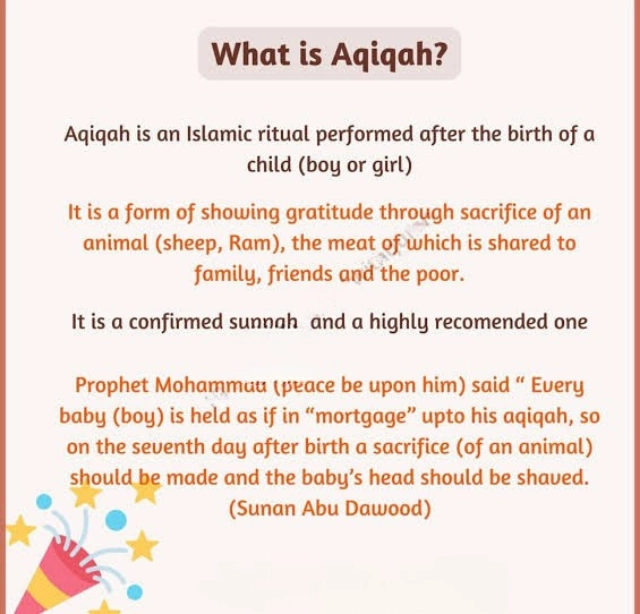
The practice of Aqeeqah is firmly established through authentic Hadith. Samurah ibn Jundab (may Allah be pleased with him) reported that the Prophet ﷺ said:
“Every child is in pledge for his Aqeeqah, which is sacrificed for him on his seventh day, his head is shaved, and he is named.” (Sunan Abu Dawood, Hadith 2838; Jami’ at-Tirmidhi, Hadith 1522, graded sahih by several hadith scholars)
This hadith outlines the three core elements of Aqeeqah the sacrifice, the shaving, and the naming — and links them together as a single act performed ideally on the seventh day after birth. Scholars have understood the phrase “in pledge” to reflect the spiritual significance of this act, linking a child’s early life to this gesture of gratitude offered on their behalf.
How Many Animals Are Sacrificed for a Boy?
A commonly asked question among new parents is how many animals should be sacrificed for a baby boy’s Aqeeqah. This is clearly addressed in a hadith narrated by Aisha (may Allah be pleased with her), who reported that the Prophet ﷺ commanded:
“For a boy, two sheep of equal age, and for a girl, one sheep.” (Sunan at-Tirmidhi, Hadith 1513; Sunan Abu Dawood, Hadith 2834)
This distinction two animals for a boy and one for a girl is widely followed across the Muslim world today. It’s worth noting that some scholars consider one animal sufficient for a boy if circumstances don’t allow for two, as the underlying intention and sincerity of the act matter most, though following the Sunnah practice of two animals is preferred where possible.
As with Qurbani, the animal sacrificed for Aqeeqah should meet the same basic requirements: it must be healthy, of an appropriate age, and slaughtered according to Islamic guidelines. Sheep and goats are the most commonly used animals, though scholars generally permit cattle as well, following the same principles applied to other Islamic sacrifices.
Aqeeqah Dua for Boy in Arabic
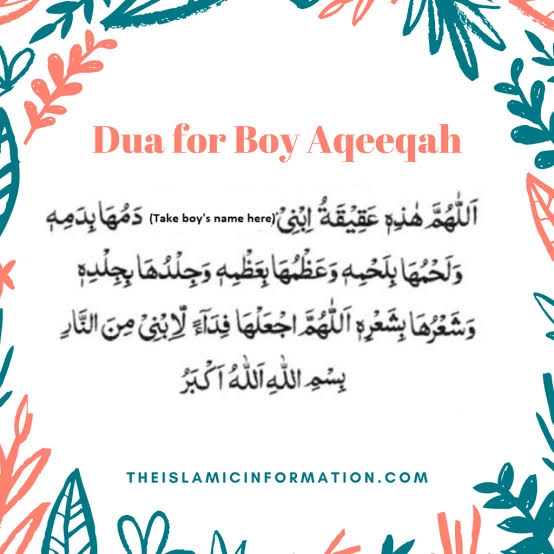
At the moment of sacrifice, it is recommended to recite a short dua dedicating the act to Allah on behalf of the child. While this dua is not from a verse of the Quran itself, it follows the general pattern of dedication recited during Islamic sacrifices, adapted specifically to include the child’s name:
Arabic: بِسْمِ اللَّهِ، اللَّهُمَّ لَكَ وَإِلَيْكَ، هَذِهِ عَقِيقَةُ [اسم الطفل]
This dua affirms that the sacrifice being offered belongs entirely to Allah a small but meaningful reminder that even in a moment of family joy, the act of worship is directed solely toward Him, not toward tradition or custom alone.
Aqeeqah Dua for Boy in English (Translation)
For parents who want to fully understand what they or their imam are reciting, here is the English translation of the Aqeeqah dua:
Translation: “In the name of Allah. O Allah, this is for You and unto You this is the Aqeeqah of [child’s name].”
This simple phrase carries deep meaning. It acknowledges Allah as the source of this new blessing, dedicates the act of sacrifice entirely to Him, and formally ties the child’s name to this moment of gratitude a beautiful way to welcome a baby boy into the fold of faith from his very first days.
Aqeeqah Dua for Boy in Roman English (Transliteration)
For those still building confidence in reading Arabic script, here is the dua written in Roman English for easier pronunciation:
Transliteration: Bismillah, Allahumma laka wa ilayka, hadhihi ‘aqeeqatu [child’s name].
When reciting this dua, simply insert your son’s name where indicated. For example, if the child’s name is Ibrahim, you would say: “Bismillah, Allahumma laka wa ilayka, hadhihi ‘aqeeqatu Ibrahim.” It’s recommended to say this dua clearly and with sincerity at the moment the sacrifice is made, ideally by the father, a family member, or the person performing the sacrifice on the family’s behalf.
When Should Aqeeqah Be Performed?
Following the hadith mentioned earlier, the Sunnah timing for Aqeeqah is the seventh day after the child’s birth. However, scholars have offered flexibility for families who are unable to perform it on the exact seventh day due to financial constraints, availability, or other valid circumstances. In such cases, it can be performed on the 14th or 21st day, or at any later point once circumstances allow, since the intention and sincerity behind the act remain the most important elements. Many Islamic butchers and organisations across the UK, USA, and Canada now offer Aqeeqah sacrifice services, making it easier for busy families to fulfil this Sunnah even without direct access to livestock themselves.
What Happens During the Aqeeqah Ceremony?
A complete Aqeeqah typically involves three connected acts, all ideally performed around the same time. First, the animals are sacrificed, with the dua recited at the moment of slaughter, dedicating the act to Allah on behalf of the newborn. Second, the baby’s head is shaved, and it is Sunnah to give charity equal to the weight of the shaved hair in silver, a beautiful practice symbolising purification and generosity from the very start of a child’s life. Third, the child is formally named, often during the same gathering, combining the joy of naming with the spiritual significance of the sacrifice a complete, unified celebration of new life rooted entirely in gratitude to Allah.
When it comes to naming, the Prophet ﷺ encouraged parents to choose names with good meaning, since a name carries significance throughout a person’s life. Many parents use the Aqeeqah gathering as the moment to formally announce a name chosen with care often reflecting a quality of faith, a Prophet’s name, or one of Allah’s beautiful attributes paired appropriately (such as Abdullah or Abdur-Rahman).
Practical Tips for Parents in the UK, USA and Canada
Performing Aqeeqah in Western countries can look a little different from how it’s traditionally done in Muslim-majority countries, but the core Sunnah remains fully achievable. Many mosques and Islamic charities in the UK, USA, and Canada now partner with certified halal butchers to handle the sacrifice professionally, allowing you to fulfil the Sunnah even in cities without direct access to farms. It’s worth reaching out to your local mosque for recommendations, as many also help distribute the meat to those in need, fulfilling the charitable dimension of Aqeeqah. If you’re performing the sacrifice yourself or attending in person, take the opportunity to recite the dua personally — it adds a deeply personal, spiritual dimension to what might otherwise feel like an administrative task handled entirely by a third party.
Common Questions About Aqeeqah Dua for Boy
Is the Aqeeqah dua obligatory to recite? While Aqeeqah itself is a confirmed Sunnah, reciting the specific dedication dua is recommended (mustahabb) rather than strictly obligatory. However, it’s encouraged as a beautiful way to consciously dedicate the act to Allah.
Can the mother recite the Aqeeqah dua instead of the father? Yes. While the father traditionally leads this act, there is no restriction preventing the mother or another family member from reciting the dua, particularly if the father is unavailable.
What if we can only afford one animal for a boy? While two animals are the preferred Sunnah practice for a boy, many scholars agree that one animal is acceptable if circumstances don’t allow for two, since sincerity and intention remain central to the act.
Can Aqeeqah be combined with Qurbani (Eid sacrifice)? Scholars generally hold that Aqeeqah and Qurbani are distinct acts of worship with separate rulings and intentions, so it’s best to perform them separately rather than combining them into a single sacrifice.
Does the child’s name need to be decided before the Aqeeqah dua is recited? It’s preferable to have decided the name beforehand, since the dua directly includes the child’s name and the naming itself is traditionally performed as part of the same occasion. If the name hasn’t been finalised, the sacrifice can still proceed, with the naming and dua completed shortly after.
What is the Dua for Aqeeqah for boys? The dua recited at the time of sacrifice is: “Bismillah, Allahumma laka wa ilayka, hadhihi ‘aqeeqatu [child’s name],” meaning “In the name of Allah. O Allah, this is for You and unto You this is the Aqeeqah of [child’s name].” The same dua is used for both boys and girls, with only the number of animals sacrificed differing between the two.
What are the rules for Aqiqah for a baby boy? For a baby boy, the Sunnah is to sacrifice two sheep or goats of similar age, ideally on the seventh day after birth. This is accompanied by shaving the baby’s head, giving charity equal to the weight of the shaved hair in silver, and formally naming the child all reflecting gratitude to Allah for the new life.
What is the Dua for Aqeeqah in English? The English translation of the Aqeeqah dua is: “In the name of Allah. O Allah, this is for You and unto You this is the Aqeeqah of [child’s name].” It’s recited at the moment of sacrifice to dedicate the act entirely to Allah on behalf of the newborn.
What are the three Aqiqah rules? The three core elements of Aqeeqah, as outlined in the hadith of Samurah ibn Jundab, are: sacrificing an animal (or animals) on the child’s behalf, shaving the newborn’s head, and giving the child a name ideally all performed on the seventh day after birth, though flexibility is allowed if circumstances require.
Final Thoughts
Aqeeqah is a beautiful Sunnah that transforms the joy of a new baby boy’s arrival into a moment of deep gratitude toward Allah. From reciting the aqeeqah dua for boy in English or Roman English, to shaving the baby’s hair and giving charity, every element of this practice reflects the Prophet’s ﷺ teaching that new life is a gift worth celebrating through worship, generosity, and sincere dua.
Whether you’re preparing for your own child’s Aqeeqah or simply learning about this Sunnah for the first time, may this guide help you approach the occasion with confidence, understanding, and a heart full of gratitude to Allah a small but meaningful step in raising a child rooted in faith from their very first days on this earth.
Disclaimer: This article is intended for general Islamic educational purposes. For matters of personal religious practice or specific fiqh rulings, please consult a qualified local scholar or imam.