Nights Understanding the Meaning of Itikaf in Ramadan
What is Itikaf in Ramadan
During the blessed month of Ramadan many Muslims look for ways to deepen their connection with Allah. One practice that carries deep spiritual meaning is Itikaf. The word Itikaf refers to staying in a place with the intention of worship and reflection. In Islam it usually means remaining inside a mosque during the last ten days of Ramadan with the intention of devoting time to prayer remembrance and recitation of the Quran.
The practice of Itikaf reminds believers to pause from the noise of daily life. It creates a quiet space where the heart can focus on faith. Through this act a person seeks closeness to Allah and hopes to witness the night known as Laylatul Qadr which carries great reward.
Itikaf Meaning in Islamic Tradition
The meaning of Itikaf becomes clearer when we look at its purpose in the teachings of Islam. In simple words Itikaf is a spiritual retreat. It is a time when a believer chooses to remain in worship and reflection for several days. The intention is not isolation from people but closeness to Allah through sincere devotion.
The practice is closely connected to the guidance found in the Quran. Muslims throughout history have understood Itikaf as a time to purify the heart and renew faith. When a person steps away from everyday distractions the soul often becomes calmer and more aware of its purpose.
The Sunnah of Itikaf in the Last Ten Days of Ramadan
Sunnah Itikaf and the Example of the Prophet
The tradition of observing Itikaf comes directly from the practice of the Prophet Muhammad. Reports from companions explain that he would perform Itikaf during the final days of Ramadan every year. This regular practice shows the importance of these nights and the value of dedicating time solely for worship.
Narrations transmitted by Aisha bint Abi Bakr describe how the Prophet would focus deeply on prayer during these nights. He encouraged believers to seek Laylatul Qadr and to increase remembrance of Allah. Because of this example Muslims around the world still follow the Sunnah of observing Itikaf during the last ten nights of Ramadan.
Why the Last Ten Nights Hold Special Importance
The final nights of Ramadan carry a special place in the hearts of believers. Within these nights lies Laylatul Qadr which is described in the Quran as a night better than a thousand months. For this reason many Muslims choose to perform Itikaf during this period so they can spend the nights in prayer reflection and recitation.
Remaining inside the mosque allows the heart to stay focused on worship without distraction. Instead of dividing time between work conversations and daily tasks a person dedicates the entire night to remembrance. This creates a peaceful environment where faith can grow and gratitude becomes stronger.
Read More : https://theorbitquran.com/
When Does Itikaf Start in Ramadan
Beginning of Itikaf in the Last Ten Nights
The time for Itikaf usually begins just before sunset on the twentieth day of Ramadan. A person enters the mosque with the intention of worship and remains there until the end of the month. This means the days and nights are spent in devotion until the sighting of the moon that marks the beginning of Eid.
Many mosques around the world prepare a quiet area for those who observe Itikaf. These spaces allow individuals to read the Quran pray voluntary prayers and reflect in peace. The intention made at the start of this period is important because every act of worship during these days becomes part of the spiritual retreat.
The Spiritual Atmosphere of These Nights
The atmosphere in mosques during the last ten nights of Ramadan often feels calm and reflective. Recitation of the Quran can be heard throughout the night while worshippers spend time in prayer or silent remembrance. Many believers describe these nights as a moment of deep peace and closeness to Allah.
The quiet environment encourages self reflection. A person begins to think about past mistakes hopes for forgiveness and plans for a better future. Through sincere prayer the heart learns patience humility and gratitude.
Conditions of Itikaf in Islam
Basic Conditions for Valid Itikaf
Islamic scholars explain that certain conditions help ensure that Itikaf is valid. The person observing Itikaf should make a clear intention and remain inside the mosque for worship. Time spent there is focused on prayer recitation of the Quran and reflection.
Scholars such as Imam Al-Nawawi explained that sincerity plays a central role in this practice. The intention should be for the sake of Allah alone. When the heart is sincere even simple acts of worship during Itikaf carry deep meaning.
Respecting the Sacred Space of the Mosque
The mosque is a place of prayer and reflection. During Itikaf a person treats the space with respect and mindfulness. Speaking gently maintaining cleanliness and avoiding unnecessary distractions helps preserve the peaceful environment.
This respect for sacred space reminds believers that the mosque is more than a building. It is a place where hearts gather in remembrance of Allah and where communities strengthen their faith together.
How to Perform Itikaf Step by Step
Preparing the Heart for Itikaf
Preparation for Itikaf begins before entering the mosque. A believer reflects on intentions and asks Allah for sincerity. This inner preparation is important because Itikaf is not only about staying in a place but about turning the heart toward worship.
Many people spend the days before the last ten nights seeking forgiveness and resolving conflicts with others. This creates a clear mind and allows the person to enter Itikaf with peace and humility.
Life Inside the Mosque During Itikaf
Once inside the mosque the routine of daily life becomes centered around worship. Time is spent reading the Quran praying voluntary prayers and making dua. Moments of quiet reflection help the heart slow down and become more aware of Allah.
Conversations are usually limited and focused on beneficial topics. Many people use this time to think about their relationship with Allah and their responsibilities toward others. The days pass gently as the soul becomes more connected to faith.
Itikaf Dua and Niyat
The Importance of Intention
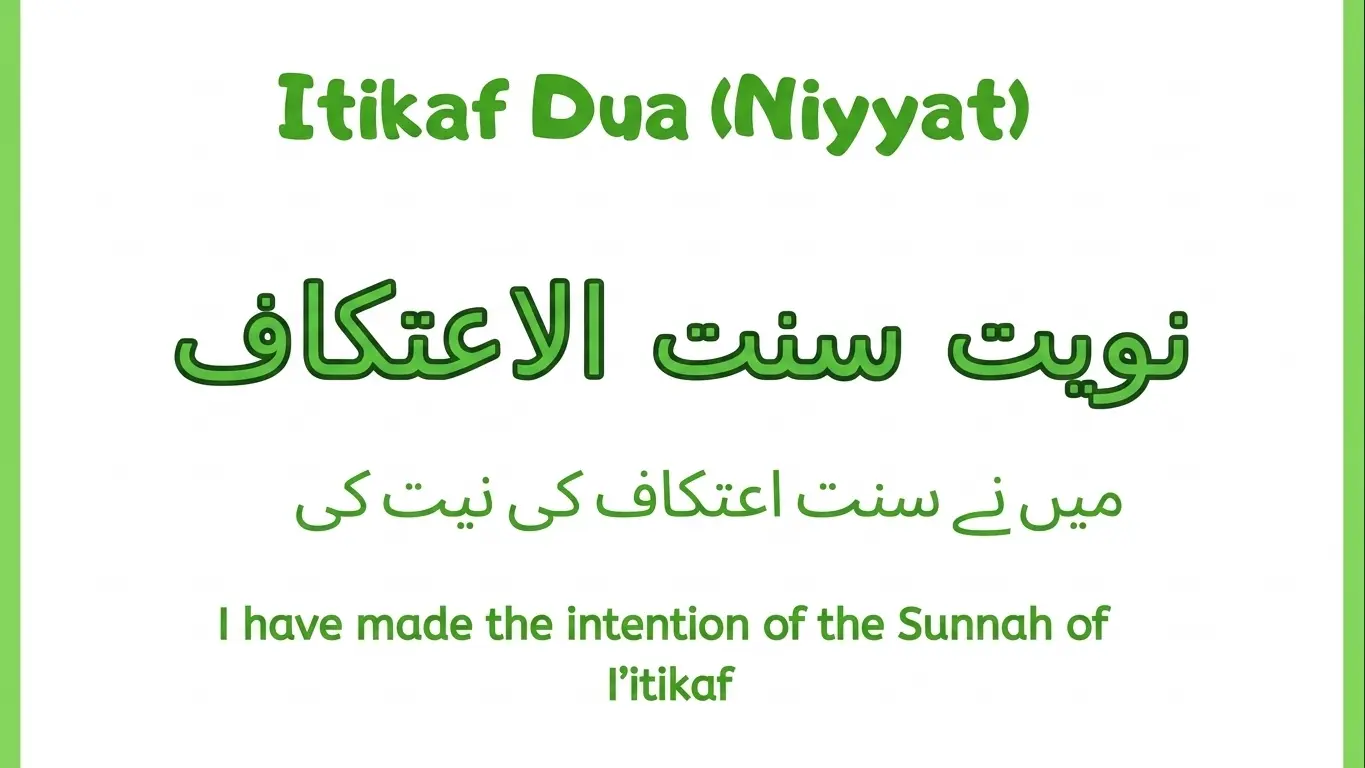
Every act in Islam begins with intention. The niyat for Itikaf simply means deciding in the heart to stay in the mosque for worship during the last ten days of Ramadan. This intention transforms ordinary time into an act of devotion.
A sincere intention helps the believer remain focused even during moments of tiredness. The heart remembers why the retreat began and continues with patience and hope.
Making Dua During Itikaf
Dua becomes an important part of life during Itikaf. Many believers spend long moments asking Allah for forgiveness guidance and mercy. The quiet nights create a space where these prayers feel especially meaningful.
One of the well known supplications associated with these nights is asking Allah for pardon and mercy. Through sincere dua the believer places their hopes and worries before their Creator with humility and trust.
Benefits of Itikaf in Ramadan
Spiritual Renewal of the Heart
One of the greatest benefits of Itikaf is the renewal of the heart. In daily life people often feel overwhelmed by responsibilities and distractions. Spending several days in worship helps calm the mind and restore spiritual focus.
Many believers find that the quiet environment allows them to reconnect with the message of the Quran. Verses feel more meaningful and prayer becomes more focused. This renewal strengthens faith and encourages a more mindful life after Ramadan.
Building Discipline and Patience
Itikaf also teaches discipline. Remaining inside the mosque for several days requires patience and commitment. A person learns to manage time carefully and focus on meaningful activities.
This discipline often continues after Ramadan. The habits of regular prayer reflection and remembrance become easier to maintain in everyday life. Through this process Itikaf helps shape character and strengthen spiritual awareness.
Read More : https://theorbitquran.com/fasting-and-the-quran-reflections-reading-quran-in-ramadan/
Itikaf for Women at Home
Understanding the Practice for Women
Many scholars explain that women may observe Itikaf in a quiet area of their home if a mosque space is not available. The intention remains the same which is to dedicate time for worship reflection and remembrance of Allah.
This practice allows women to experience the spiritual atmosphere of the last ten nights even while fulfilling family responsibilities. The quiet space at home becomes a place of prayer where the heart focuses on faith.
Creating a Peaceful Environment at Home
A small prayer area can help create a calm environment for worship. During these nights many women spend time reading the Quran making dua and reflecting on the meaning of Ramadan.
The goal is not isolation from family but creating moments of stillness where the heart can turn toward Allah. Even within a home setting the spirit of Itikaf can bring peace and renewed faith.
Common Questions About Itikaf Rules
Rules of Itikaf in Islam

Islamic teachings provide guidance for those observing Itikaf. Remaining inside the mosque for worship and avoiding unnecessary activities helps maintain the purpose of the retreat. Leaving the mosque is generally limited to essential needs.
The focus remains on acts that bring the heart closer to Allah. Reciting the Quran prayer remembrance and reflection form the center of daily life during these days.
Maintaining Balance During the Retreat
Although Itikaf is a time of devotion it is also a time for reflection and rest. Short moments of sleep help maintain strength for night prayer and recitation. Balance allows the believer to continue worship with sincerity and calmness.
The goal is not hardship but sincere devotion. Through moderation a person can maintain focus and make the most of these blessed nights.
The Role of Laylatul Qadr During Itikaf
Seeking the Night of Great Value
Laylatul Qadr is one of the most meaningful nights in Islam. It is described in the Quran as a night better than a thousand months. Because its exact date is not known Muslims increase worship during the last ten nights.
Itikaf allows a believer to remain in prayer during these nights with hope of witnessing this special moment. The quiet hours before dawn become a time for heartfelt supplication and reflection.
Spiritual Reflection During These Nights
Many believers use these nights to reflect on their life journey. They ask Allah for forgiveness for past mistakes and guidance for the future. The calm environment of the mosque encourages honesty and humility in prayer.
Through this reflection the heart becomes softer and more aware of the blessings of faith.
Read More : https://theorbitquran.com/ramadan-second-ashra-forgiveness/
Living the Spirit of Itikaf Beyond Ramadan
Carrying the Lessons Into Daily Life
The days spent in Itikaf often leave a lasting impression on the heart. Many people discover a deeper love for prayer and remembrance of Allah. These habits can continue even after Ramadan ends.
When believers return to daily routines they carry the lessons of patience gratitude and mindfulness. The quiet reflection experienced during Itikaf reminds them to pause and remember Allah throughout the year.
Strengthening Faith Through Consistency
Faith grows when acts of worship become part of daily life. Even small moments of remembrance or recitation can bring peace to the heart. The experience of Itikaf helps believers realize the value of these simple practices.
Through consistency the connection with Allah becomes stronger and more meaningful.
A Gentle Reflection for the Heart
As Ramadan reaches its final nights many believers feel a mixture of hope and reflection. The days of fasting and prayer slowly come to an end but the lessons of the month remain. Itikaf offers a quiet moment to pause and think about the journey of faith.
In these calm hours a believer remembers that life moves quickly and every moment is a chance to draw closer to Allah. The prayer whispered in the night the verse of the Quran read with reflection and the sincere hope for forgiveness all shape the heart in meaningful ways. As the month ends many people carry a quiet intention to keep their faith alive throughout the coming year with patience gratitude and trust in Allah.
Itikaf in Ramadan Meaning Rules Benefits and How to Perform Itikaf
Itikaf in Ramadan
What is Itikaf in Ramadan
Itikaf in Ramadan is a spiritual practice where a Muslim stays in a mosque for a specific period of time with the intention of worshiping Allah and focusing completely on faith. During Itikaf, a person limits worldly activities and spends time in prayer, Quran recitation, reflection, and remembrance of Allah. This practice becomes especially important during the last days of Ramadan when believers search for deeper connection with their Creator.
The purpose of Itikaf is to create a peaceful space where distractions of daily life are reduced. Muslims use this time to strengthen their faith and renew their spiritual goals. Many scholars explain that Itikaf helps the heart slow down and reconnect with the message of the Quran. Through quiet worship and reflection, a believer begins to feel the true spirit of Ramadan and develops a stronger awareness of Allah in daily life.
Read More : https://theorbitquran.com/preservation-of-the-holy-quran/
Itikaf Last Ten Nights of Ramadan
The last ten nights of Ramadan hold a special place in Islamic tradition, and this is the time when many Muslims observe Itikaf. These nights are considered the most spiritually powerful period of the entire month because they include Laylat al Qadr, the Night of Decree. By entering Itikaf during these nights, a believer dedicates their time entirely to worship and reflection.
During this period, Muslims spend their days and nights in prayer, Quran recitation, remembrance of Allah, and quiet contemplation. The environment of the mosque helps create a sense of unity and focus among worshippers who share the same intention. The last ten nights offer a unique opportunity to step away from routine life and devote time to spiritual growth. Through patience and sincerity, believers hope that their prayers will be accepted and that their hearts will become closer to Allah.
Sunnah Itikaf Last 10 Days
Sunnah Itikaf during the last ten days of Ramadan is a practice that follows the example of Prophet Muhammad. According to authentic narrations, the Prophet observed Itikaf regularly during this period every year. Because of this, many Muslims consider it a highly recommended act of worship that carries great spiritual value.
Following the Sunnah helps believers feel connected to the prophetic tradition. When Muslims perform Itikaf during the final days of Ramadan, they try to imitate the dedication and devotion shown by the Prophet. This act is not only about staying in the mosque but also about focusing the heart on sincere worship. Sunnah Itikaf encourages patience, humility, and reflection. It reminds believers that true spiritual growth often comes from quiet moments spent remembering Allah and reflecting on the guidance found in the Quran.
What is Itikaf
Itikaf Meaning in Islam
In Islam, Itikaf refers to staying in a mosque with the intention of worshiping Allah and dedicating time to spiritual reflection. The practice encourages believers to pause their daily routines and spend focused time strengthening their relationship with their Creator. Itikaf is not only about physical presence in a mosque but also about directing the heart and mind toward worship.
Muslims who perform Itikaf engage in acts such as prayer, Quran recitation, supplication, and remembrance of Allah. Scholars explain that this practice allows the soul to slow down and reconnect with faith in a peaceful environment. In a world filled with constant activity and distraction, Itikaf offers a chance to return to simplicity and devotion. The spiritual meaning of Itikaf reminds believers that the purpose of life is ultimately connected to worship and awareness of Allah.
Spiritual Purpose of Itikaf
The spiritual purpose of Itikaf is to allow a believer to disconnect from worldly distractions and focus entirely on their relationship with Allah. In everyday life, people often become busy with work, responsibilities, and personal concerns. Itikaf provides a rare opportunity to step away from these activities and return to the center of faith.
During this period of worship, the heart becomes more attentive to prayer and reflection. Many Muslims use this time to read the Quran slowly and thoughtfully, seeking deeper understanding of its message. The quiet environment of the mosque encourages sincerity and humility. Itikaf also allows believers to examine their actions, ask forgiveness, and renew their intentions for the future. Through this spiritual retreat, a person may feel a sense of peace and clarity that strengthens their faith long after Ramadan ends.
Why Muslims Observe Itikaf in Ramadan
Muslims observe Itikaf in Ramadan because this month is already filled with spiritual blessings and opportunities for worship. The Quran was revealed during Ramadan, and believers are encouraged to increase their devotion during this sacred time. Itikaf becomes a way to deepen that experience and fully embrace the spirit of the month.
By observing Itikaf, Muslims aim to strengthen their connection with Allah through consistent worship. Many people find that daily routines make it difficult to focus deeply on spiritual reflection. Ramadan creates a special environment where believers feel motivated to increase prayer and remembrance of Allah. Itikaf builds on that motivation by providing a dedicated period of worship. For many Muslims, these days become a turning point that helps them grow spiritually and carry the lessons of Ramadan into the rest of the year.
Read More : https://theorbitquran.com/contact-us/
Itikaf Meaning
Linguistic Meaning of Itikaf
The linguistic meaning of Itikaf comes from the Arabic root word that refers to staying or remaining in a place with dedication and commitment. In everyday Arabic language, the term can describe someone who devotes themselves to a particular activity or remains focused on a specific purpose. This idea of devotion and persistence forms the foundation of the Islamic understanding of Itikaf.
In a spiritual sense, the linguistic meaning highlights the concept of staying in a place for worship and reflection. It suggests a deliberate pause from daily life in order to concentrate on something meaningful. When Muslims observe Itikaf, they are essentially dedicating their time and presence to the worship of Allah. The word itself reflects a deep sense of commitment, reminding believers that spiritual growth often requires patience, focus, and the willingness to step away from distractions.
Islamic Definition of Itikaf
In Islamic teachings, Itikaf is defined as staying in a mosque with the intention of worshiping Allah for a specific period of time. The practice involves dedicating oneself to prayer, Quran recitation, remembrance of Allah, and reflection. Scholars emphasize that intention plays an essential role in this act of worship. Without sincere intention, simply staying in the mosque would not fulfill the purpose of Itikaf.
The Islamic definition also highlights the importance of spiritual focus. A person observing Itikaf aims to reduce unnecessary conversations and worldly activities. Instead, the time is spent seeking closeness to Allah and reflecting on personal faith. Many scholars describe Itikaf as a form of spiritual retreat within Islam. Through this retreat, believers create a calm environment where the heart can reconnect with the guidance of the Quran and the teachings of Prophet Muhammad.
Historical Practice of Itikaf in Islam
The historical practice of Itikaf dates back to the time of Prophet Muhammad. Authentic narrations mention that the Prophet regularly observed Itikaf during the last ten days of Ramadan. His companions also followed this tradition and continued the practice after his lifetime. Because of this strong historical foundation, Itikaf remains an important act of worship in many Muslim communities today.
Throughout Islamic history, scholars and believers have viewed Itikaf as a time of deep reflection and spiritual renewal. Mosques around the world host worshippers who gather during the final days of Ramadan to dedicate themselves to prayer and Quran recitation. The historical continuity of this practice shows how strongly it is connected to Islamic tradition. By observing Itikaf today, Muslims feel linked to generations of believers who sought closeness to Allah through the same peaceful act of devotion.
Types of Itikaf in Islam
Different forms of Itikaf exist in Islamic tradition depending on intention and duration. Understanding these types helps Muslims practice Itikaf correctly and appreciate its spiritual flexibility.
| Type of Itikaf | When It Is Performed | Obligation Level | Duration | Purpose | Common Practice |
|---|---|---|---|---|---|
| Sunnah Itikaf | Last ten days of Ramadan | Highly recommended (Sunnah Mu’akkadah) | From 20th Ramadan sunset until Eid moon sighting | Seeking Laylatul Qadr and deep worship | Observed in mosques worldwide |
| Nafl Itikaf | Any time during the year | Voluntary | Can be a few hours or days | Extra devotion and spiritual reflection | Often done after prayers |
| Wajib Itikaf | When someone makes a vow (nazr) | Obligatory once vowed | Depends on the vow | Fulfillment of a promise to Allah | Rare but recognized in fiqh |
| Short Itikaf | Brief stay in mosque with intention | Voluntary | Minutes or hours | Gain reward during spare time | Many scholars encourage this |
| Community Itikaf | Organized by mosques | Collective Sunnah fulfillment | Last 10 days of Ramadan | Encourages community worship | Common in large mosques |
| Individual Itikaf | Personal retreat | Voluntary or Sunnah | Depends on intention | Personal reflection and private worship | Quiet and introspective |
Recommended Acts During Itikaf
While observing Itikaf, believers try to fill their time with meaningful acts of worship. The goal is not simply staying inside the mosque but engaging in actions that strengthen faith and spiritual awareness.
| Act of Worship | Description | Spiritual Benefit | Recommended Time | Example Practice | Practical Tip |
|---|---|---|---|---|---|
| Quran Recitation | Reading and reflecting on the Quran | Deepens understanding of Allah’s guidance | After Fajr or late night | Completing one Juz daily | Read slowly with translation |
| Dhikr (Remembrance of Allah) | Repeating phrases praising Allah | Brings peace and mindfulness | Throughout the day | SubhanAllah, Alhamdulillah | Use quiet moments for dhikr |
| Tahajjud Prayer | Late night voluntary prayer | Increases closeness to Allah | Last third of the night | Two or more rak’ah | Wake up before Fajr |
| Islamic Reflection | Thinking about personal faith and life | Strengthens self-awareness | Quiet moments | Journaling reflections | Avoid phone distractions |
| Learning Islamic Knowledge | Reading tafsir or hadith | Expands religious understanding | Afternoon or evening | Study short tafsir passages | Bring Islamic books |
| Making Dua | Asking Allah for mercy and guidance | Builds spiritual connection | Especially at night | Personal heartfelt prayers | Write a dua lis |
15 Important Issues of I’tikaf
1. The I’tikaf of the last ten days of Ramadan is Sunnah Kifayah. This means that if some people from the locality perform this Sunnah, the right of the mosque will be fulfilled. If no one performs I’tikaf in the mosque, then all the people of the locality will be sinful.
2. For the Sunnah I’tikaf of the last ten days, it is necessary to enter the mosque with the intention of I’tikaf before sunset on the 20th of Ramadan. If even a few moments pass after sunset without I’tikaf, then it will not be Sunnah I’tikaf but will become Nafl (voluntary) I’tikaf.
3. If someone leaves the mosque without any Shari‘ah-based or natural necessity, the Sunnah I’tikaf ends. Even if someone leaves the mosque by mistake, the Sunnah I’tikaf ends and it becomes Nafl I’tikaf. In such a case, Qada (making up) of I’tikaf should be performed. This means being present in the mosque with the intention of I’tikaf before Maghrib and staying until Maghrib the next day. In Qada I’tikaf, fasting is also obligatory. The Qada may be performed during Ramadan with the obligatory fasts or after Eid with a fast. However, fasting is necessary with Qada I’tikaf; without fasting, Qada I’tikaf is not valid.
4. One should confirm the boundaries of the mosque from the mosque committee. Often the surrounding areas and attachments of the mosque are considered part of the mosque, and people move there, whereas this ends the Sunnah I’tikaf. I’tikaf is valid only within the actual boundaries of the mosque. Usually people go to the place where shoes are kept and perform some necessary tasks, whereas that place is not part of the mosque in the Shari‘ah. Therefore great care is required that no one goes outside the original boundaries of the mosque.
5. Remaining completely silent in I’tikaf is not necessary; rather it is Makruh. However, one should speak good or permissible words and avoid arguments and useless talk.
6. During I’tikaf one should make a routine of prayer, recitation of the Qur’an, remembrance of Allah, and reading Islamic literature. Good conversation is allowed, but bad, useless, and meaningless talk should be avoided. Listening to news or reading newspapers during I’tikaf is against the etiquette of the mosque and I’tikaf, therefore it should be avoided. However, reading books based purely on religious literature is permissible.
7. A person in I’tikaf may give the Adhan, even if the place of Adhan is outside the mosque boundaries. The person in I’tikaf cannot go out for worship or for a funeral prayer. However, if he goes out for a natural need and sees that the funeral prayer is starting, he may join it. Similarly, while passing on the way, he may visit a sick person.
8. For a person in I’tikaf, it is not permissible to leave the mosque for a voluntary ablution (renewing ablution while already having ablution) or for a Sunnah bath such as the Friday bath. As soon as he leaves and goes to the washroom for this, the I’tikaf breaks. However, if a person does not have ablution and wants to perform ablution for voluntary worship such as recitation or Nafl prayers, he may go out for that. The Friday bath is neither a natural necessity nor a Shari‘ah necessity, therefore it is not permissible to go out for it during Sunnah I’tikaf. However, it is permissible that when one goes for urination, after finishing he may pour a few containers of water over his body in the washroom and return quickly, in less time than it takes to perform ablution. Since it does not involve extra time or a separate intention of bathing, this method is permissible.
There is no proof that the Messenger of Allah ﷺ went out of the mosque during Sunnah I’tikaf for the Friday bath.
9. In hot weather, it is not permissible for a person in I’tikaf to leave the mosque boundaries only to take a bath for cooling. However, if he goes to the washroom for ablution or a natural need, he may pour water over himself there and bathe, but he should not take extra time and should finish quickly, in about the time required for ablution.
10. After ablution, standing in the ablution area to dry the water, leaving the mosque to wash hands for eating, or washing hands and face with soap without the intention of ablution invalidates I’tikaf, because the ablution area is not part of the mosque according to Shari‘ah. Therefore, it is necessary to be very careful and not remain there without a Shari‘ah need.
11. If a person becomes seriously ill and it becomes difficult to stay in I’tikaf, it is better if the doctor can come to the place of I’tikaf. Otherwise, the person may leave for treatment. In this case the I’tikaf breaks, but he will only have to perform Qada of one fast and one day and night of I’tikaf, and he will not be sinful. The Qada can be performed in the same Ramadan since the fasts are still continuing, or after Ramadan with a fast. However, Qada I’tikaf is not valid without fasting.
12. Using a mobile phone without necessity.
Using a mobile phone, especially a smartphone, without necessity during I’tikaf is not appropriate and should be avoided. However, using it to check time or to read religious literature on the phone is permissible, although avoiding it is better. If there is a strong need, it should be turned off immediately after fulfilling the need for better concentration in worship.
13. The method of ending I’tikaf.
As soon as the announcement of the Eid moon is made, the Sunnah I’tikaf automatically ends. No specific action is required to end it. A person may leave the I’tikaf then, but if he stays in the mosque for worship on the night of Eid, it is a matter of great reward, although it is not obligatory.
14. Some unnecessary customs.
Some people consider it necessary to congratulate the person who performed I’tikaf and arrange a meal invitation at their home or invite them to another home on that night. If this does not happen, it sometimes leads to displeasure. All of this is merely a custom and should be avoided.
15. Is there any specific supplication for I’tikaf?
There is no specific supplication for I’tikaf. However, the Prophet ﷺ encouraged making the following supplication especially during the last ten days of Ramadan.
حضرت عائشہ رضی اللہ عنہا سے روایت ہے کہ میں نے نبی کریم ﷺ سے دریافت کیا کہ اگر مجھے لیلۃ القدر کا پتہ چل جائے تو میں اس رات کیا کہوں؟ آپ ﷺ نے ارشاد فرمایا: یہ کہو:
اَللَّهُمَّ إِنَّكَ عَفُوٌّ تُحِبُّ الْعَفْوَ فَاعَفُ عَنِّي۔
(📚مُسند احمد)
Ramadan: Virtues and Rules
Important Questions about Iʿtikāf
From Fatawa Mahmoodiya, Volume 15, these questions and answers are presented for guidance:
- Is Iʿtikāf in the last ten days of Ramadan obligatory or Sunnah?
Answer: It is a confirmed Sunnah that some people perform. - Who can do Iʿtikāf from the following people:
(1) Slave (2) Leper (3) Blind (4) Ignorant (5) Eunuch (6) Hermaphrodite (7) Non-prayer person (8) Non-fasting person (9) Mute or deaf (10) Mentally weak (11) Poor (12) Mad person (13) Debtor (14) Sinner (15) Pregnant woman near delivery
Answer according to number:
- (2) If they have bad smell or others feel disgusted, they should not stay in the mosque.
- (5) If they repent, they can do Iʿtikāf in the mosque.
- (6) Same rule applies.
- (7) When they do Iʿtikāf in the mosque, they must also pray.
- (8) When doing Iʿtikāf in the last ten days, they must also fast.
- (10) If they cannot respect the mosque, they should not enter or do Iʿtikāf.
- (12) Same rule applies.
- (14) If they do not commit sins in the mosque, they can do Iʿtikāf.
- (15) Can do Iʿtikāf at home.
Other people have problems doing Iʿtikāf.
- Does a person have to sit in the mosque for Iʿtikāf, or can he stay at home?
Answer: Men cannot do Iʿtikāf at home; it must be in the mosque. - If no man does Iʿtikāf in the mosque, but a woman does it at home, is it valid?
Answer: Her Iʿtikāf is valid, but men’s Sunnah is not fulfilled. - If there is a designated place for women in the mosque, can a woman do Iʿtikāf there?
Answer: She should do it at home. Her Iʿtikāf does not count for men’s Sunnah. - Does Iʿtikāf require the mosque to have adhan (call to prayer) and congregation?
Answer: Iʿtikāf should be done where adhan and five-time congregational prayers are arranged. It is not done in empty places or places without a mosque. - If a person doing Iʿtikāf dies on 24th Ramadan, what is the ruling?
Answer: Allah will forgive them. They intended to complete ten days, so they will get the reward. - If two people each do five days of Iʿtikāf instead of ten together, is it valid?
Answer: No, the Sunnah is not completed this way. - If the mosque is big, how far can the person doing Iʿtikāf walk?
Answer: They can move in the part of the mosque used for prayer, but should not walk around without reason. - Can the person doing Iʿtikāf talk to others when going to the bathroom?
Answer: Only if necessary. Do not go out or stay to chat, and do not say anything against Iʿtikāf. - If there are plants in the mosque, can the person take care of them?
Answer: Only use water inside the prayer area; do not go outside unnecessarily. - If there is a garden next to the mosque, can the person supervise it or shoo birds while sitting inside?
Answer: They cannot go there, but can supervise without moving outside. - If construction work is happening in the mosque, can the person work there for charity?
Answer: Yes, if they do not need to leave the mosque. - If a woman doing Iʿtikāf at home starts menstruation or is forced to have intercourse, and then bathes, is her Iʿtikāf valid?
Answer: The first Iʿtikāf ends, the second begins. If it happens in the last ten days, the Sunnah is not completed. - If a man doing Iʿtikāf goes home for cleaning and sees his wife and has intercourse, then bathes and resumes Iʿtikāf, is it valid?
Answer: Same as 14. - If the wife brings food to the mosque and the person kisses her, what is the ruling?
Answer: It is not allowed, but this alone does not break Iʿtikāf. - If a person going for Iʿtikāf becomes insane on 24th Ramadan, what is the ruling?
Answer: He is no longer responsible, Allah will restore his health. - If a close relative of the person dies, can they attend the funeral?
Answer: Leaving the mosque ends Iʿtikāf. - If the wife or child dies, can the person handle the burial?
Answer: Same rule. Iʿtikāf ends, though they are not sinful if necessary.