
Introduction
Learning the full namaz steps is one of the first goals for any new Muslim, revert, or student of Islam living in the UK, USA, or Canada. Salah is the second pillar of Islam, and Allah describes it in the Quran as a duty “decreed upon the believers a decree of specified times” (Surah An-Nisa, 4:103).
This guide walks through how to pray Islam five times a day, from preparation to the final salam, using the Arabic wording, transliteration, and English translation for each step.
This article is written for beginners and general readers who want full namaz steps in English explained clearly, along with authentic Hadith references, so that the steps followed are grounded in the Sunnah rather than guesswork.
Preparing Before You Begin Salah
Before starting namaz, three conditions must be met. First, the body, clothing, and place of prayer must be clean. Second, wudu (ablution) must be performed correctly, washing the hands, mouth, nose, face, arms, head, ears, and feet in the prescribed order.
Third, the person must face the Qiblah, the direction of the Kaaba in Makkah. In the UK, USA, and Canada, most mosque apps and prayer apps provide an accurate Qiblah direction based on GPS location, which is especially useful for beginners praying at home or work.
The Prophet Muhammad (peace be upon him) said: “Pray as you have seen me praying” (Sahih al-Bukhari, Hadith 631). This hadith is the foundation for why the steps of Salah are followed precisely as demonstrated by the Prophet himself, rather than performed according to personal preference.
Read More : theorbitquran.com
Step 1: Niyyah (Intention)
Salah begins with niyyah, the intention to pray a specific prayer for the sake of Allah. Niyyah is made in the heart; it does not need to be spoken aloud, though some people find it helpful to mentally state which prayer they are performing.
For example, a person may intend in their heart: “I intend to pray two rak’ahs of Fajr prayer for the sake of Allah.” This intention immediately precedes the opening takbir.
Step 2: Takbeer-ul-Ihram (Opening the Prayer)
The prayer formally begins by raising both hands to shoulder or ear level and saying “Allahu Akbar” (Allah is the Greatest). This is called Takbeer-ul-Ihram, and it marks the point where worldly speech and movement become forbidden until the prayer ends.
After the opening takbir, the hands are folded, with the right hand placed over the left forearm or wrist, resting below the chest, based on the authentic narration recorded in Sahih al-Bukhari, Hadith 707.
Step 3: Qiyam (Standing) and Recitation
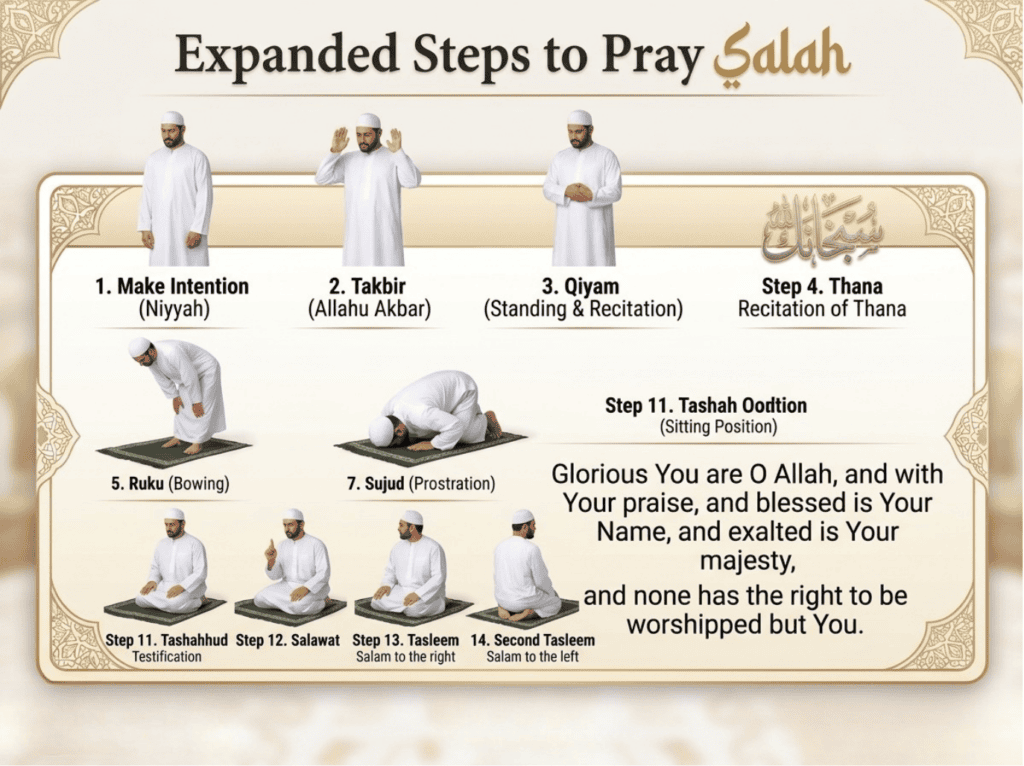
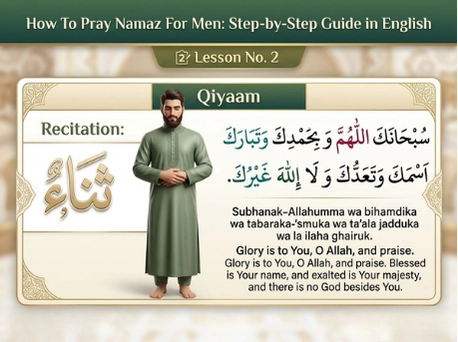
While standing, many Muslims recite an opening supplication known as Thana: “Subhanaka Allahumma wa bihamdika, wa tabarakasmuka, wa ta’ala jadduka, wa la ilaha ghairuk,” meaning “Glory be to You, O Allah, and praise be to You, blessed is Your name, exalted is Your majesty, and there is no god but You.”
Following this, Surah Al-Fatihah is recited in every rak’ah, as the Prophet Muhammad (peace be upon him) said: “There is no prayer for the one who does not recite Surah Al-Fatihah” (Sahih al-Bukhari, Hadith 756). After Al-Fatihah, a short surah or a few verses from the Quran are recited, particularly in the first two rak’ahs.
Read More : https://theorbitquran.com/surah-al-inshirah-benefits-background-and-spiritual-practices/
Step 4: Ruku (Bowing)
After completing the recitation, the worshipper says “Allahu Akbar” and bends forward at the waist, placing the hands firmly on the knees with the back kept flat and level. This position is called Ruku.
While in Ruku, it is Sunnah to say “Subhana Rabbiyal Azeem” (Glory be to my Lord, the Magnificent) three times or more. Rising from Ruku, the worshipper says “Sami Allahu liman hamidah” (Allah hears whoever praises Him), followed by standing upright and saying “Rabbana lakal hamd” (Our Lord, to You belongs all praise).
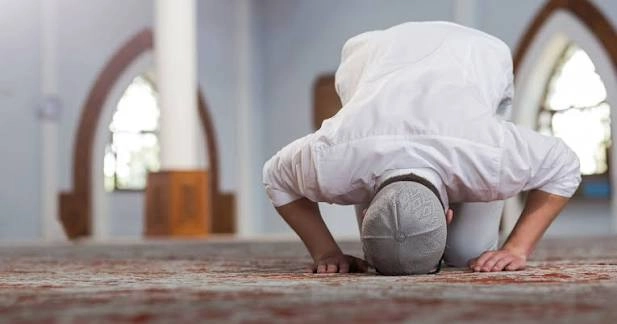
Step 5: Sujood (Prostration)
From standing, the worshipper says “Allahu Akbar” and goes down into Sujood, placing the forehead, nose, both palms, both knees, and the toes of both feet on the ground. The Prophet Muhammad (peace be upon him) said: “Be straight in the prostrations and none of you should put his forearms on the ground like a dog” (Sahih al-Bukhari, Hadith 785).
While prostrating, it is Sunnah to say “Subhana Rabbiyal A’la” (Glory be to my Lord, the Most High) three times or more. The worshipper then rises briefly to a sitting position, saying “Allahu Akbar,” and recites “Rabbighfirli” (My Lord, forgive me) before performing a second prostration in the same manner.
Read More : https://theorbitquran.com/pregnancy-surah-nuh-ayat-10-12-benefits/
Step 6: Completing the Rak’ah
After the second prostration, the worshipper stands again, saying “Allahu Akbar,” to begin the next rak’ah, repeating the recitation, Ruku, and Sujood as before. This full cycle, from standing recitation to two prostrations, forms one complete rak’ah.
Different prayers require different numbers of rak’ahs. Fajr consists of two rak’ahs, Dhuhr and Asr consist of four each, Maghrib consists of three, and Isha consists of four, though the specific structure of sunnah and fard rak’ahs varies slightly across these five daily prayers.
Step 7: Tashahhud (Sitting Recitation)
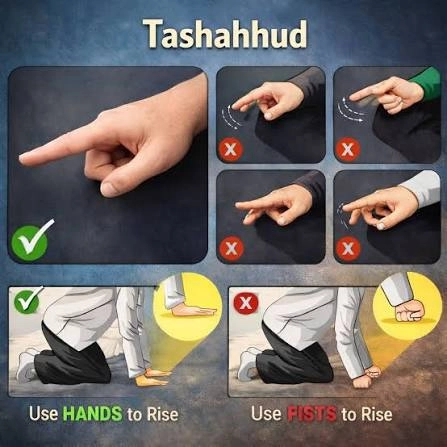
After completing two rak’ahs, or at the final rak’ah of a prayer, the worshipper sits and recites Tashahhud: “At-tahiyyatu lillahi was-salawatu wat-tayyibatu, as-salamu ‘alaika ayyuhan-nabiyyu wa rahmatullahi wa barakatuh, as-salamu ‘alaina wa ‘ala ‘ibadillahis-saliheen, ash-hadu al-la ilaha illallah wa ash-hadu anna Muhammadan ‘abduhu wa rasuluh.”
This translates roughly to: “All greetings, prayers, and good things are due to Allah. Peace be upon you, O Prophet, and the mercy of Allah and His blessings. Peace be upon us and upon the righteous servants of Allah. I bear witness that there is no god but Allah, and I bear witness that Muhammad is His servant and messenger.”
Step 8: Durood and Final Dua
In the final sitting of the prayer, after Tashahhud, Durood Ibrahim is recited, sending blessings upon the Prophet Muhammad (peace be upon him) and Prophet Ibrahim (peace be upon him). The Prophet then said worshippers may add a personal supplication of their choosing before finishing the prayer (Sahih al-Bukhari, Hadith 797).
This is often a moment beginners are encouraged to use for sincere, heartfelt dua in their own language, since Allah knows every language and every intention of the heart, even before words are spoken.
Read More : https://theorbitquran.com/darood-tanjeena-benefits/
Step 9: Taslim (Ending the Prayer)
The prayer concludes with Taslim, turning the head to the right while saying “Assalamu alaikum wa rahmatullah” (Peace and mercy of Allah be upon you), then turning the head to the left and repeating the same phrase. This marks the formal end of the Salah.
Companions of the Prophet, including Itban bin Malik, reported that they prayed alongside the Prophet and always finished their prayer with this Taslim (Sahih al-Bukhari, Hadith 800), confirming this closing step as an established part of every prayer.
Read More : Contact Us
The Five Daily Prayers at a Glance
Muslims are required to pray five times daily: Fajr before sunrise, Dhuhr after the sun passes its zenith, Asr in the mid to late afternoon, Maghrib just after sunset, and Isha once darkness has fully set in. Each has a specific window of time, which mosque timetables and prayer apps in the UK, USA, and Canada calculate automatically based on location.
Allah says in the Quran: “Establish prayer for My remembrance” (Surah Taha, 20:14), highlighting that Salah is fundamentally an act of connection with Allah, repeated throughout the day regardless of how busy daily life becomes.
Common Mistakes Beginners Make
New reciters often rush through the positions without pausing to reflect on the meaning of what is being said. Others forget the order of movements, particularly the transition between Ruku and standing, or between the two prostrations.
A well-known hadith describes a man who prayed quickly without proper stillness; the Prophet told him three times to repeat his prayer, saying “Go back and pray, for you have not prayed,” before teaching him the correct method (Sahih al-Bukhari, Hadith 757; Sahih Muslim, Hadith 397). This hadith is often cited to remind beginners that calmness and precision matter more than speed.
Conclusion
Learning the full namaz steps takes practice, patience, and repetition, but every stage of Salah is rooted in what the Prophet Muhammad (peace be upon him) himself demonstrated and taught his companions. From the opening takbir to the final taslim, each movement and each phrase carries both linguistic meaning and spiritual purpose.
For beginners in the UK, USA, and Canada learning how to pray Islam five times a day, the most important step is simply to start, using this guide alongside a local imam, teacher, or trusted app for pronunciation practice, and to improve gradually with consistency rather than aiming for perfection immediately.
Frequently Asked Questions
What are the full namaz steps in English? The main steps are niyyah, Takbeer-ul-Ihram, Qiyam with recitation, Ruku, Sujood, sitting for Tashahhud, Durood, personal dua, and Taslim, repeated according to the rak’ah count of each prayer.
What do you say in each step of Salah? Each step has specific wording, including Takbir (“Allahu Akbar”), Surah Al-Fatihah during Qiyam, “Subhana Rabbiyal Azeem” in Ruku, “Subhana Rabbiyal A’la” in Sujood, and Tashahhud during the sitting position.
How many times a day do Muslims pray? Muslims pray five times daily: Fajr, Dhuhr, Asr, Maghrib, and Isha, each within its own specified time window.
Can namaz be learned from a hadith reference? Yes, the core method of Salah is based on the hadith “Pray as you have seen me praying” (Sahih al-Bukhari, Hadith 631), meaning the Prophet’s demonstrated practice is the model for every step.
Is it necessary to understand the Arabic while praying? Understanding the meaning is encouraged and deepens concentration, though the Arabic wording itself must be recited as taught, since translation is not a substitute for the original recitation in Salah.
Disclaimer: This article is intended for general educational purposes to introduce the full namaz steps to beginners and general readers. It is not a substitute for direct guidance from a qualified Islamic teacher or imam, and readers are encouraged to practice alongside in-person or verified instruction to perfect pronunciation and movements.