The final two verses of Surah At-Tawbah (also written as Surah Tauba) hold a truly special place in the Quran. Known simply as the “surah tauba last ayat,” these verses were, according to several companions of the Prophet Muhammad (peace be upon him), the very last revelation to descend before his passing. For centuries, Muslims across the UK, USA, and Canada have turned to these two short ayat for comfort, protection, and a renewed sense of reliance on Allah. In this post, we will walk through the Arabic text, the English translation, authentic tafsir from classical scholars, and the well-known Hadith that explains the benefits of reciting them. Whether you are a beginner learning about the Quran or simply looking to strengthen your daily worship, this guide will give you a clear and reliable understanding of why these verses matter so much.
What Is Surah At-Tawbah (Surah Tauba)?
Surah At-Tawbah, meaning “The Repentance,” is the ninth chapter of the Quran and contains 129 verses. It is unique among all 114 surahs because it is the only one that does not begin with “Bismillah ir-Rahman ir-Raheem.” Scholars explain that this is because the surah continues the themes of the previous chapter, Surah Al-Anfal, and deals largely with matters of warfare, treaties, and the hypocrites of Madinah. It is a Madinan surah, revealed after the Prophet’s migration to Madinah, during a period when the early Muslim community was consolidating its strength. While much of the surah addresses serious and sometimes stern themes, it closes on an entirely different note — one of mercy, compassion, and complete trust in Allah. This closing shift is what makes the surah tauba last ayat so remarkable to reflect upon.
Read More : The Virtues and Blessings of Surah Al-Baqarah: A Complete Guide
Surah Tauba Last Ayat in Arabic
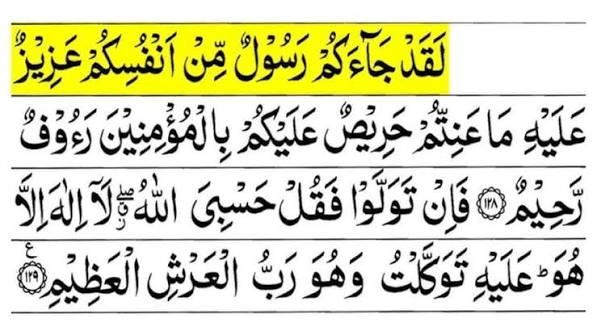
The final two verses of the surah, ayat 128 and 129, read as follows in Arabic:
Ayah 128: لَقَدْ جَاءَكُمْ رَسُولٌ مِّنْ أَنفُسِكُمْ عَزِيزٌ عَلَيْهِ مَا عَنِتُّمْ حَرِيصٌ عَلَيْكُم بِالْمُؤْمِنِينَ رَءُوفٌ رَّحِيمٌ
Ayah 129: فَإِن تَوَلَّوْا فَقُلْ حَسْبِيَ اللَّهُ لَا إِلَٰهَ إِلَّا هُوَ ۖ عَلَيْهِ تَوَكَّلْتُ ۖ وَهُوَ رَبُّ الْعَرْشِ الْعَظِيمِ
These two verses are often written together and recited as a single unit, which is why they are commonly referred to as the “surah tauba last 2 ayat.”
Surah Tauba Last 2 Ayat Translation (English)
Understanding the meaning of these verses is just as important as reciting them correctly. Below is a reliable English rendering of both ayat, drawn from standard Quranic translations available on Quran.com.
Ayah 128: “There has certainly come to you a Messenger from among yourselves. Grievous to him is what you suffer; he is concerned over your guidance, and to the believers he is kind and merciful.”
Ayah 129: “But if they turn away, say: Sufficient for me is Allah; there is no deity except Him. On Him I have relied, and He is the Lord of the Great Throne.”
You can read the full verse with word-by-word translation on Quran.com — Surah At-Tawbah 9:128-129.
This surah tauba last ayat translation shows two distinct but connected messages. The first verse describes the Prophet’s deep love and concern for his followers, while the second teaches every believer how to respond when people reject truth or turn away — by placing complete trust, or tawakkul, in Allah alone.
Tafsir: The Meaning Behind These Verses
Classical commentators, including scholars referenced in Tafsir Ibn Kathir (Quran.com), explain that ayah 128 highlights three qualities of the Prophet Muhammad (peace be upon him): he came from among the people themselves, so his character was known and trusted; he was deeply pained by the hardships his people faced; and he was overflowing with compassion specifically toward the believers. This is not a generic kindness but a Prophetic mercy rooted in genuine care for the guidance and wellbeing of the Muslim community. Ayah 129 then shifts the focus to the believer’s own response to hardship or rejection. According to Sayyidna Ubayy ibn Ka’b and Sayyidna Ibn Abbas, these were the last verses revealed to the Prophet before his death, which is why many scholars regard them as a final, concentrated lesson: no matter what happens around you, your sufficiency, your protection, and your reliance rest with Allah, the Lord of the Great Throne.
Surah Tauba Last Ayat Benefits
One of the most frequently asked questions about these verses concerns their benefits, and there is authentic guidance on this from Hadith literature. According to a narration recorded in Sunan Abi Dawood 5081 (Sunnah.com), Abu Darda (may Allah be pleased with him) reported that the Prophet Muhammad (peace be upon him) said that whoever recites “Hasbiyallahu la ilaha illa Huwa, alayhi tawakkaltu wa Huwa Rabbul Arshil Azeem” seven times in the morning and seven times in the evening, Allah will suffice him in whatever concerns him. This is precisely the second half of ayah 129, and it is why so many Muslims incorporate this short phrase into their daily morning and evening adhkar. The benefit described is not superstition or a magical formula; rather, it reflects the spiritual reality that consistent remembrance of Allah, combined with sincere trust in Him, brings ease, protection, and inner peace to a believer’s life, especially during times of worry or difficulty.
How and When to Recite the Last Ayat of Surah Tauba
There is no single obligatory method for reciting these verses, but the Hadith tradition gives clear guidance on timing. Many scholars recommend reciting the phrase “Hasbiyallahu la ilaha illa Huwa, alayhi tawakkaltu wa Huwa Rabbul Arshil Azeem” seven times after Fajr prayer and again seven times after Asr or before Maghrib, in line with the morning and evening adhkar tradition. It can be recited with wudu or without it, since this is remembrance (dhikr) rather than a requirement tied to ritual purity. Some people prefer to recite the full two ayat, including verse 128, as a complete unit, while others focus specifically on the dua found in verse 129. Either approach is acceptable, as the goal is sincere, consistent remembrance rather than a rigid ritual. For beginners, setting a simple daily reminder after Fajr and Asr prayers is often the easiest way to build this habit.
Lessons for Muslims Today
Beyond their historical significance as the final revealed verses, the surah tauba last ayat offer a timeless lesson for Muslims living in the UK, USA, Canada, and anywhere else in the world. In times of uncertainty, whether personal, financial, or social, these verses remind believers that ultimate sufficiency comes from Allah alone. The Prophet’s compassion described in ayah 128 also teaches us how to treat one another with mercy and genuine concern, following his example. Meanwhile, ayah 129 offers a practical, repeatable dua that anyone can memorize in minutes and carry with them through daily life. For new Muslims or students of the Quran, starting with short but powerful sections like this is an excellent way to build a habit of daily Quranic engagement without feeling overwhelmed by longer memorization goals.
Conclusion
The surah tauba last ayat are far more than just the closing lines of the ninth chapter of the Quran; they are a concentrated reminder of Prophetic mercy and the believer’s complete reliance on Allah. From their Arabic text and English translation to their tafsir and the authentic Hadith describing their benefits, these two verses offer beginners and experienced reciters alike a simple yet profound practice to add to their daily routine. By reflecting on their meaning and reciting them consistently, morning and evening, Muslims can carry forward the same trust in Allah that these final revealed words were meant to instill.
FAQs
1. What are the last ayat of Surah Tauba? The last ayat of Surah Tauba are verses 128 and 129, which describe the Prophet’s mercy toward believers and teach the dua “Hasbiyallahu la ilaha illa Huwa, alayhi tawakkaltu wa Huwa Rabbul Arshil Azeem.”
2. Why is Surah Tauba the only surah without Bismillah? Scholars explain this is because Surah At-Tawbah continues the themes of the previous surah, Al-Anfal, and deals with matters of treaties and warfare, so the Companions did not add Bismillah at its start.
3. What is the benefit of reciting Surah Tauba’s last two ayat? Based on a Hadith in Sunan Abi Dawood, reciting the dua in ayah 129 seven times in the morning and seven times in the evening brings Allah’s sufficiency in one’s worldly and religious affairs.
4. Can I recite these verses without wudu? Yes, since this is a form of dhikr (remembrance) rather than Quran recitation tied strictly to ritual purity, it can be said with or without wudu.
5. Were these really the last verses revealed in the Quran? According to Sayyidna Ubayy ibn Ka’b and Ibn Abbas, these two verses are considered among the very last revealed to the Prophet Muhammad (peace be upon him) before his passing.
FAQ Section (Standalone Copy)
Q1: What are the last ayat of Surah Tauba? A: Verses 128–129, describing the Prophet’s mercy and the dua “Hasbiyallahu la ilaha illa Huwa, alayhi tawakkaltu wa Huwa Rabbul Arshil Azeem.”
Q2: Why is Surah Tauba the only surah without Bismillah? A: Because it continues the themes of Surah Al-Anfal on treaties and warfare, so Companions did not prefix it.
Q3: What is the benefit of reciting Surah Tauba’s last two ayat? A: Per Sunan Abi Dawood, reciting the dua seven times morning and evening brings Allah’s sufficiency in one’s affairs.
Q4: Can I recite these verses without wudu? A: Yes, it is dhikr and can be recited with or without wudu.
Q5: Were these really the last verses revealed in the Quran? A: According to Ubayy ibn Ka’b and Ibn Abbas, yes — they are considered among the final verses revealed.
References: Quran.com (Surah At-Tawbah 9:128–129), Sunnah.com (Sunan Abi Dawood 5081), Tafsir Ibn Kathir