
Introduction
Patience, known in Arabic as Sabr (صَبْر), is one of the most repeated themes in the entire Quran. It is mentioned in over ninety verses, either directly or through related concepts such as endurance, steadfastness, and trust in Allah during hardship. For a believer, patience is not passive suffering it is an active, disciplined response to trials that strengthens faith and draws a person closer to Allah.
This guide brings together the most important Quran verses about patience, presented with their original Arabic text, transliteration, and English translation. You will also find authentic Hadith that explain how the Prophet Muhammad (peace be upon him) practiced and taught Sabr, along with practical steps for applying patience in daily life. Whether you are facing a personal struggle, financial hardship, illness, or simply seeking to strengthen your character, these verses offer timeless guidance rooted directly in the Quran and Sunnah.
Why Patience (Sabr) Matters in Islam
In Islamic teaching, patience is considered half of faith, paired with gratitude (shukr) as the two responses a believer uses to navigate every situation in life — ease and hardship alike. Allah tests every soul, and the Quran makes clear that trials are not a sign of Allah’s displeasure but a means of purification and elevation in rank. Sabr appears in three main forms in classical scholarship: patience in obeying Allah, patience in avoiding sin, and patience in accepting what Allah has decreed.
Unlike the everyday understanding of “waiting quietly,” Islamic patience is active. It involves controlling anger, avoiding complaint, continuing to pray and worship during hardship, and maintaining good character even when circumstances are painful. The Quran repeatedly links patience with divine reward, often promising that the patient will receive blessings, mercy, and guidance beyond what can be measured. This is why Sabr is treated not as a minor virtue but as a foundational pillar of a believer’s character.
Read More : theorbitquran.com
Quran Verses About Patience in Arabic With Translation
Below are some of the most frequently cited Quran verses about patience, each presented with Arabic script, transliteration, and a clear English translation for easy understanding.
1. Surah Al-Baqarah (2:153)
Arabic: يَا أَيُّهَا الَّذِينَ آمَنُوا اسْتَعِينُوا بِالصَّبْرِ وَالصَّلَاةِ ۚ إِنَّ اللَّهَ مَعَ الصَّابِرِينَ
Transliteration: Ya ayyuhal-ladhina amanus-ta’inu bis-sabri was-salah, innal-laha ma’as-sabirin.
Translation: O you who believe, seek help through patience and prayer. Indeed, Allah is with those who are patient.
This verse is often the first one taught to beginners because it directly instructs believers on how to cope with difficulty — by turning to patience and prayer together, not separately. It also gives the powerful assurance that Allah’s presence and support accompany those who remain patient.
Read More : https://theorbitquran.com/pregnancy-surah-nuh-ayat-10-12-benefits/
2. Surah Al-Baqarah (2:155–157)
Arabic: وَلَنَبْلُوَنَّكُمْ بِشَيْءٍ مِّنَ الْخَوْفِ وَالْجُوعِ وَنَقْصٍ مِّنَ الْأَمْوَالِ وَالْأَنفُسِ وَالثَّمَرَاتِ ۗ وَبَشِّرِ الصَّابِرِينَ
Transliteration: Wa lanabluwannakum bi shay’im-minal-khawfi wal-ju’i wa naqsim-minal-amwali wal-anfusi wath-thamarat, wa bashshiris-sabirin.
Translation: And We will surely test you with something of fear, hunger, loss of wealth, lives, and fruits — but give glad tidings to the patient.
The verses that follow (156–157) describe the believer who, upon facing loss, responds by affirming that everything belongs to Allah and returns to Him. Allah promises such people blessings, mercy, and true guidance three rewards named explicitly in the text.
3. Surah Aal-e-Imran (3:200)
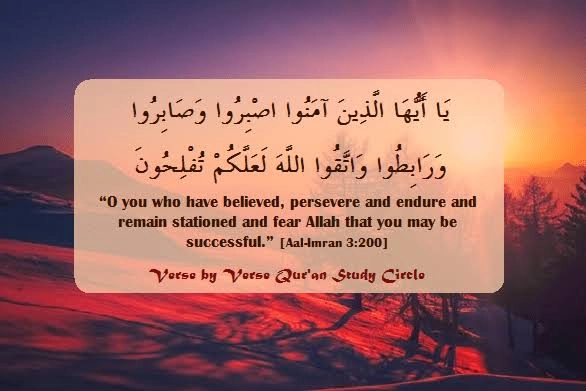
Arabic: يَا أَيُّهَا الَّذِينَ آمَنُوا اصْبِرُوا وَصَابِرُوا وَرَابِطُوا وَاتَّقُوا اللَّهَ لَعَلَّكُمْ تُفْلِحُونَ
Transliteration: Ya ayyuhal-ladhina amanus-biru wa sabiru wa rabitu wattaqul-laha la’allakum tuflihun.
Translation: O you who believe, be patient, outdo one another in patience, remain firm, and fear Allah — so that you may succeed.
This is one of the most direct Quran verses about patience and success, since it ends with the word tuflihun, meaning “you may prosper” or “you may succeed.” Patience here is described in three escalating stages: personal endurance, mutual encouragement in patience, and steadfast resolve.
Read More : https://theorbitquran.com/full-namaz-steps-in-english/
Quran Verse About Patience and Success
Believers searching for a Quran verse about patience and success often refer back to Surah Aal-e-Imran (3:200) above, but two additional verses reinforce this connection clearly.
Surah Az-Zumar (39:10)
Arabic: إِنَّمَا يُوَفَّى الصَّابِرُونَ أَجْرَهُم بِغَيْرِ حِسَابٍ
Transliteration: Innama yuwaffas-sabiruna ajrahum bi-ghayri hisab.
Translation: Indeed, the patient will be given their reward without measure.
Scholars note that this promise is unique most good deeds are rewarded according to a set measure, but patience is rewarded without limit. This reflects how highly Allah values the quality of steadfast endurance during hardship.
Surah Ash-Sharh (94:5–6)
Arabic: فَإِنَّ مَعَ الْعُسْرِ يُسْرًا * إِنَّ مَعَ الْعُسْرِ يُسْرًا
Transliteration: Fa inna ma’al-‘usri yusra, inna ma’al-‘usri yusra.
Translation: So indeed, with hardship comes ease. Indeed, with hardship comes ease.
Repeated twice for emphasis, this short but powerful verse teaches that ease is not something that follows hardship eventually it exists alongside it. For students, professionals, or anyone facing prolonged struggle, this verse is frequently cited as a source of hope and reassurance that success and relief are near.
Read More : Aqeeqah Dua for Boy in English: Complete Guide, Meaning & Rulings
Authentic Hadith on Patience (Sabr)
The Prophet Muhammad (peace be upon him) elaborated extensively on patience, and several of his sayings are recorded in the most trusted hadith collections.
Narrated by Anas ibn Malik, the Prophet said: “Verily, patience is at the first stroke of a calamity.” (Sahih al-Bukhari, Hadith 1302). This teaches that true patience is shown in the initial moment of shock and grief, not after emotions have already settled.
In another narration, the Prophet said: “Whoever remains patient, Allah will make him patient. Nobody is given a gift better or more comprehensive than patience.” (Sahih al-Bukhari, Hadith 1469). This hadith reassures believers that patience can be developed through practice and sincere effort, and it is described as the greatest gift a person can receive.
The Prophet also said that no fatigue, illness, sorrow, sadness, or even the prick of a thorn befalls a believer except that Allah forgives some of their sins because of it (Sahih al-Bukhari, Hadith 5641–5642; Sahih Muslim, Hadith 2573). This hadith is authentic and widely cited to show that patience during even minor hardships carries spiritual benefit.
It is worth noting that some popular sayings about patience circulate online without a verified chain of narration. Readers are encouraged to rely only on hadith found in recognized collections such as Sahih al-Bukhari, Sahih Muslim, Sunan Abu Dawood, Sunan an-Nasa’i, and Sunan Ibn Majah, and to consult a qualified scholar when uncertain about a narration’s authenticity.
How to Practice Patience in Daily Life

Applying Sabr practically is what transforms it from a concept into a lived habit. Begin by pausing before reacting to frustration the Prophet’s example shows that patience is most tested in the very first moment of distress, so a short pause for reflection or a quiet dua can prevent a hasty, regretful response.
Maintaining regular prayer during difficult periods is another practical step, since Surah Al-Baqarah (2:153) links patience directly with prayer as a joint source of strength. Reciting short verses like Surah Ash-Sharh during stressful moments can also serve as a personal reminder that ease is near.
Finally, avoiding complaint to others about one’s hardships, while still seeking support from trusted family, friends, or professionals when genuinely needed, reflects the balance the Quran encourages: enduring with dignity while not neglecting one’s wellbeing.
Read More : Shab e Barat Dua Dua for Forgiveness 15th Shaban Islamic Supplications
Frequently Asked Questions
What is the main Quran verse about patience? Surah Al-Baqarah (2:153) is widely regarded as the foundational verse, instructing believers to seek help through patience and prayer, with the assurance that Allah is with those who are patient.
Which Quran verse links patience to success? Surah Aal-e-Imran (3:200) directly connects patience with success, ending with the phrase “la’allakum tuflihun,” meaning “so that you may succeed.”
Is patience mentioned only in a few verses of the Quran? No. Patience and related concepts appear in more than ninety verses throughout the Quran, making it one of the most emphasized virtues in Islamic teaching.
What hadith describes true patience? The Prophet’s statement that “patience is at the first stroke of a calamity” (Sahih al-Bukhari 1302) is one of the most cited hadith describing genuine patience.
Can patience really bring relief from hardship? According to Surah Ash-Sharh (94:5–6), ease accompanies hardship rather than following it afterward, offering believers reassurance during difficult times.
Read More : Contact Us
Conclusion
The Quran’s teachings on patience offer more than comfort during hardship — they provide a complete framework for facing life’s trials with faith, dignity, and hope. From Surah Al-Baqarah’s call to seek help through patience and prayer, to Surah Aal-e-Imran’s promise of success for the steadfast, these verses remind believers that every difficulty carries the seed of relief and reward. Paired with the Prophet’s own teachings on Sabr, this guidance equips Muslims of any background to face uncertainty with a calm, resilient heart, trusting that Allah’s promise to the patient is never delayed without wisdom.
Disclaimer: This article is intended for general educational purposes. While every effort has been made to cite authentic Quranic verses and hadith with accurate references, readers are encouraged to verify rulings and interpretations with a qualified Islamic scholar for matters relevant to their personal practice.
FAQs
- What is the main Quran verse about patience? Surah Al-Baqarah (2:153) is widely regarded as the foundational verse, instructing believers to seek help through patience and prayer, with the assurance that Allah is with those who are patient.
- Which Quran verse links patience to success? Surah Aal-e-Imran (3:200) directly connects patience with success, ending with the phrase “la’allakum tuflihun,” meaning “so that you may succeed.”
- Is patience mentioned only in a few verses of the Quran? No. Patience and related concepts appear in more than ninety verses throughout the Quran, making it one of the most emphasized virtues in Islamic teaching.
- What hadith describes true patience? The Prophet’s statement that “patience is at the first stroke of a calamity” (Sahih al-Bukhari 1302) is one of the most cited hadith describing genuine patience.
- Can patience really bring relief from hardship? According to Surah Ash-Sharh (94:5–6), ease accompanies hardship rather than following it afterward, offering believers reassurance during difficult times.